Application
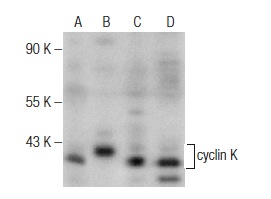
Western blot analysis of cyclin K expression in 3T3-L1 (A), SW480 (B), c4 (C) and F9 (D) whole cell lysates.| Product Name | cyclin K Antibody (H-180) |
|---|---|
| Antibody Type | Primary Antibodies |
| Antigen Alias | epitope corresponding to amino acids 107-286 mapping within an internal region of cyclin K of human origin |
| Modification Notes | Positive transcription elongation factor b (P-TEFb) complexes are crucial for allowing the elongation of RNA by RNA polymerase II (RNAPII). These complexes are able to phosphorylate the carboxyl-terminal domain of the largest RNAPII subunit. P-TEFb complexes are made up of a catalytic subunit, cyclin dependent kinase 9 (Cdk9), and one of the regulatory cyclins, CycT1, CycT2a, CycT2b or cyclin K. Specifically, cyclin K forms an active P-TEFb complex with Cdk9. This complex promotes transcription by phosphorylating the carboxyl-terminal domain of RNAPII which allows the elongation of transcription to proceed. Cyclin K is ubiquitously expressed in adult mouse and human tissues, with highest levels expressed in the developing germ cells of adult testis and ovaries. Cyclin K is also present in HepG2 cells. The cyclin K gene encodes a 357 amino acid protein and maps to human chromosome 14q32. |
| Clonality | Polyclonal |
|---|---|
| Isotype | IgG |
| Host Species | Rabbit |
| Tested Applications | WBIPIFELISA |
| recommended for detection of cyclin K of mouse, rat and human origin by WB, IP, IF and ELISA also reactive with additional species, including canine, bovine, porcine and avian: |
|
| Species Reactivity | HumanMouseRat |
| Concentration | 1mg/ml |
| Purification | Affinity purified |
| Alternative Names | epitope corresponding to amino acids 107-286 mapping within an internal region of cyclin K of human origin |
|---|---|
| Tissue Specificity | epitope corresponding to amino acids 107-286 mapping within an internal region of cyclin K of human origin |
| Entrez Gene | 8812 |
|---|
Application
Western blot analysis of cyclin K expression in 3T3-L1 (A), SW480 (B), c4 (C) and F9 (D) whole cell lysates.| Application Notes | recommended for detection of cyclin K of mouse, rat and human origin by WB, IP, IF and ELISA also reactive with additional species, including canine, bovine, porcine and avian: |
|---|
| Form | Liquid |
|---|---|
| Storage Instructions | For short-term storage, store at 4° C. For long-term storage, aliquot and store at -20ºC or below. Avoid multiple freeze-thaw cycles. |
| Storage Buffer | phosphate buffered saline , pH 7.4, 150mM NaCl, 0.02% sodium azide and 50% glycerol. |


