Application
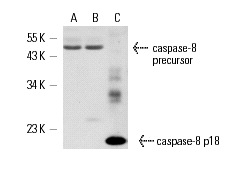
Western blot analysis of caspase-8 expression in Jurkat (A) and HL-60 (B) whole cell lysates and human recombinant caspase-8 p18 (C).| Product Name | caspase-8 p18 Antibody (H-134) |
|---|---|
| Antibody Type | Primary Antibodies |
| Antigen Alias | epitope corresponding to amino acids 217-350 mapping within the caspase-8 p18 subunit of human origin |
| Modification Notes | Initiator caspases, which include caspase-8, activate effector caspases by cleaving inactive forms of effector caspases. In the activation cascade responsible for apoptosis induced by TNFRSF1A and mediated by TNFRSF6/FAS, caspase-8 is the most upstream protease. Caspase-8 binds to adaptor molecule FADD, forming an aggregate referred to as death-inducing signaling complex (DISC), which activates caspase-8. The actived protein is released from the complex and further activates downstream apoptotic proteases. Caspase-8, which is a heterodimer consisting of two subunits (p18 and p10), is widely expressed, but is detected at highest levels in peripheral blood leukocytes (PBLs), thymus, liver and spleen. Defects in CASP8, the gene encoding for caspase-8, may cause CASP8D (caspase-8 deficiency disorder), which is characterized by splenomegaly and CD95-induced apoptosis of PBLs, and may lead to immunodeficiency due to defects in T lymphocyte, NK cell and B lymphocyte activation. |
| Clonality | Polyclonal |
|---|---|
| Isotype | IgG |
| Host Species | Rabbit |
| Tested Applications | WBIPIFELISA |
| recommended for detection of the p18 subunit and precursor of caspase-8 of mouse, rat and human origin by WB, IP, IF and ELISA: |
|
| Species Reactivity | HumanMouseRat |
| Concentration | 1mg/ml |
| Purification | Affinity purified |
| Alternative Names | epitope corresponding to amino acids 217-350 mapping within the caspase-8 p18 subunit of human origin |
|---|---|
| Tissue Specificity | epitope corresponding to amino acids 217-350 mapping within the caspase-8 p18 subunit of human origin |
| Entrez Gene | 841 |
|---|
Application
Western blot analysis of caspase-8 expression in Jurkat (A) and HL-60 (B) whole cell lysates and human recombinant caspase-8 p18 (C).| Application Notes | recommended for detection of the p18 subunit and precursor of caspase-8 of mouse, rat and human origin by WB, IP, IF and ELISA: |
|---|
| Form | Liquid |
|---|---|
| Storage Instructions | For short-term storage, store at 4° C. For long-term storage, aliquot and store at -20ºC or below. Avoid multiple freeze-thaw cycles. |
| Storage Buffer | phosphate buffered saline , pH 7.4, 150mM NaCl, 0.02% sodium azide and 50% glycerol. |


