Application
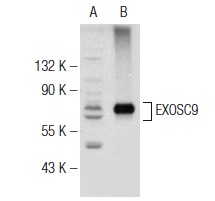
Western blot analysis of EXOSC9 expression in non-transfected: (A) and mouse EXOSC9 transfected: (B) 293T whole cell lysates.| Product Name | EXOSC9 Antibody (H-300) |
|---|---|
| Antibody Type | Primary Antibodies |
| Antigen Alias | epitope corresponding to amino acids 1-300 mapping at the N-terminus of EXOSC9 of human origin |
| Modification Notes | The exosome is a multisubunit complex composed of several highly conserved subunits, some of which are 3’ to 5’ exoribonucleases. The complex is involved in a variety of cellular processes and is responsible for degrading unstable mRNAs that contain AU-rich (ARE) elements in their untranslated 3’ region. EXOSC9 (exosome component 9), also called p5, p6, PM/Scl-75 or RRP45, is a component of the exosome complex and is required for processing of 7S pre-RNA to mature 5.8S rRNA. Located in the nucleus and cytoplasm, EXOSC9 is a ribonuclease that is involved in mRNA degradation, but does not contribute to stability of the exosome complex. Unlike most of the exosome subunits, EXOSC9 is thought to act both independently and as a member of the exosome, thus making it an essential part of ARE-mediated mRNA decay. EXOSC9 is proteolytically cleaved during apoptosis and is implicated in certain autoimmune diseases such as myositis and scleroderma. Four isoforms of this protein exist due to alternative splicing events. |
| Clonality | Polyclonal |
|---|---|
| Isotype | IgG |
| Host Species | Rabbit |
| Tested Applications | WBIPIFELISA |
| recommended for detection of EXOSC9 of mouse, rat and human origin by WB, IP, IF and ELISA also reactive with additional species, including equine, canine, bovine, porcine and avian: |
|
| Species Reactivity | HumanMouseRat |
| Concentration | 1mg/ml |
| Purification | Affinity purified |
| Alternative Names | epitope corresponding to amino acids 1-300 mapping at the N-terminus of EXOSC9 of human origin |
|---|---|
| Tissue Specificity | epitope corresponding to amino acids 1-300 mapping at the N-terminus of EXOSC9 of human origin |
Application
Western blot analysis of EXOSC9 expression in non-transfected: (A) and mouse EXOSC9 transfected: (B) 293T whole cell lysates.| Application Notes | recommended for detection of EXOSC9 of mouse, rat and human origin by WB, IP, IF and ELISA also reactive with additional species, including equine, canine, bovine, porcine and avian: |
|---|
| Form | Liquid |
|---|---|
| Storage Instructions | For short-term storage, store at 4° C. For long-term storage, aliquot and store at -20ºC or below. Avoid multiple freeze-thaw cycles. |
| Storage Buffer | phosphate buffered saline , pH 7.4, 150mM NaCl, 0.02% sodium azide and 50% glycerol. |


