Application
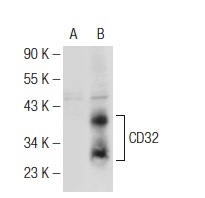
Western blot analysis of CD32 expression in non-transfected: (A) and human CD32 transfected: (B) 293T whole cell lysates.| Product Name | CD32-A/B/C Antibody (H-206) |
|---|---|
| Antibody Type | Primary Antibodies |
| Antigen Alias | epitope corresponding to amino acids 1-206 mapping at the N-terminus of CD32 of human origin |
| Modification Notes | CD32 (also designated Fc gamma RII) is a low affinity receptor for the Fc fragment of aggregated IgG (1,2). CD32 is responsible for the clearance of immunocomplexes by macrophages and also plays an important role in the regulation of antibody production by B cells (1-4). IgG can noncooperatively bind either one or two highly glycosylated CD32 molecules, and this binding delivers a negative signal for B cells (1,2,5). CD32 exists as several isoforms that are produced by alternative splicing of three distinct genes, A, B, and C (2,6). These isoforms are designated FcgRIIA, FcgRIIB1, FcgRIIB3, and FcgRIIC (1,2,6). All isoforms are present on monocytes, placental trophoblasts and endothelial cells (1,6). In addition, the FcgRIIB forms are present on B lymphocytes, and the FcgRIIA and FcgRIIC forms are found on neutrophils (1,6). |
| Clonality | Polyclonal |
|---|---|
| Isotype | IgG |
| Host Species | Rabbit |
| Tested Applications | WBIPIFELISA |
| recommended for detection of CD32-A, B and C of human origin and to a lesser extent Fc γ RIIb and Fc γ RIII of mouse origin and the corresponding rat homolog by WB, IP, IF and ELISA: |
|
| Species Reactivity | HumanMouseRat |
| Concentration | 1mg/ml |
| Purification | Affinity purified |
| Alternative Names | epitope corresponding to amino acids 1-206 mapping at the N-terminus of CD32 of human origin |
|---|---|
| Tissue Specificity | epitope corresponding to amino acids 1-206 mapping at the N-terminus of CD32 of human origin |
| Entrez Gene | 2212 |
|---|
Application
Western blot analysis of CD32 expression in non-transfected: (A) and human CD32 transfected: (B) 293T whole cell lysates.| Application Notes | recommended for detection of CD32-A, B and C of human origin and to a lesser extent Fc γ RIIb and Fc γ RIII of mouse origin and the corresponding rat homolog by WB, IP, IF and ELISA: |
|---|
| Form | Liquid |
|---|---|
| Storage Instructions | For short-term storage, store at 4° C. For long-term storage, aliquot and store at -20ºC or below. Avoid multiple freeze-thaw cycles. |
| Storage Buffer | phosphate buffered saline , pH 7.4, 150mM NaCl, 0.02% sodium azide and 50% glycerol. |


