Application
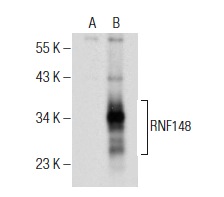
Western blot analysis of RNF148 expression in non-transfected: (A) and human RNF148 transfected: (B) 293T whole cell lysates.| Product Name | RNF148 Antibody (G-11) |
|---|---|
| Antibody Type | Primary Antibodies |
| Antigen Alias | epitope mapping near the N-terminus of RNF148 of human origin |
| Modification Notes | The RING-type zinc finger motif is present in a number of viral and eukaryotic proteins and is made of a conserved cysteine-rich domain that is able to bind two zinc atoms. Proteins that contain this conserved domain are generally involved in the ubiquitination pathway of protein degradation. RNF148 (RING finger protein 148) is a 305 amino acid single-pass membrane protein that contains one PA (protease associated) domain and a single RING-type zinc finger. RNF148 is encoded by a gene that maps to human chromosome 7, which houses over 1,000 genes and comprises nearly 5% of the human genome. Chromosome 7 has been linked to Osteogenesis imperfecta, Pendred syndrome, Lissencephaly, Citrullinemia and Shwachman-Diamond syndrome. The deletion of a portion of the q arm of chromosome 7 is associated with Williams-Beuren syndrome, a condition characterized by mild mental retardation, an unusual comfort and friendliness with strangers and an elfin appearance. |
| Clonality | Polyclonal |
|---|---|
| Isotype | IgG |
| Host Species | Rabbit |
| Tested Applications | WBIPIFELISA |
| recommended for detection of RNF148 of mouse, rat and human origin by WB, IP, IF and ELISA non cross-reactive with other RNF family members also reactive with additional species, including equine, canine, bovine and porcine: |
|
| Species Reactivity | HumanMouseRat |
| Concentration | 1mg/ml |
| Purification | Affinity purified |
| Alternative Names | epitope mapping near the N-terminus of RNF148 of human origin |
|---|---|
| Tissue Specificity | epitope mapping near the N-terminus of RNF148 of human origin |
| Entrez Gene | 378925 |
|---|
Application
Western blot analysis of RNF148 expression in non-transfected: (A) and human RNF148 transfected: (B) 293T whole cell lysates.| Application Notes | recommended for detection of RNF148 of mouse, rat and human origin by WB, IP, IF and ELISA non cross-reactive with other RNF family members also reactive with additional species, including equine, canine, bovine and porcine: |
|---|
| Form | Liquid |
|---|---|
| Storage Instructions | For short-term storage, store at 4° C. For long-term storage, aliquot and store at -20ºC or below. Avoid multiple freeze-thaw cycles. |
| Storage Buffer | phosphate buffered saline , pH 7.4, 150mM NaCl, 0.02% sodium azide and 50% glycerol. |


