Application
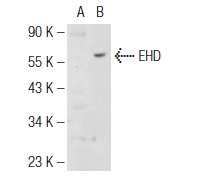
Western blot analysis of EHD expression in non-transfected: (A) and mouse EHD transfected: (B) 293T whole cell lysates.| Product Name | EHD Antibody (H-210) |
|---|---|
| Antibody Type | Primary Antibodies |
| Antigen Alias | epitope corresponding to amino acids 241-450 mapping within an internal region of EHD1 of human origin |
| Modification Notes | The Eps15 homology (EH) domain-containing protein family consists of four members, EHD1, EHD2, EHD3, and EHD4 (1). The chromosomal locations of the human EHD genes are as follows: EHD1 maps to 11q13, EHD2 maps to 19q13.3, EHD3 maps to 2p21, and EHD4 maps to 15q11.1 (1-3). The encoded proteins of all EHD family members contain multiple conserved regions, which include an amino-terminal nucleotide-binding consensus site, a bipartite nuclear localization signal, and a carboxy-terminal EH protein-binding domain with an EF-hand motif (3,4). EHD1 is ubiquitously expressed with increased expression in testis (2,3). EHD2, EHD3, and EHD4 have more specific expression with EHD2 highly expressed in heart, EHD3 expressed in brain, kidney, liver, placenta, ovary, and heart, and EHD4 expressed in heart, placenta, and pancreas (1,5,6). The EHD proteins may participate in ligand-induced endocytosis (3-5). |
| Clonality | Polyclonal |
|---|---|
| Isotype | IgG |
| Host Species | Rabbit |
| Tested Applications | WBIPIFELISA |
| recommended for detection of EHD1-4 of mouse, rat and human origin by WB, IP, IF and ELISA also reactive with additional species, including equine, canine, bovine, porcine and avian: |
|
| Species Reactivity | HumanMouseRat |
| Concentration | 1mg/ml |
| Purification | Affinity purified |
| Alternative Names | epitope corresponding to amino acids 241-450 mapping within an internal region of EHD1 of human origin |
|---|---|
| Tissue Specificity | epitope corresponding to amino acids 241-450 mapping within an internal region of EHD1 of human origin |
| Entrez Gene | 10938 |
|---|
Application
Western blot analysis of EHD expression in non-transfected: (A) and mouse EHD transfected: (B) 293T whole cell lysates.| Application Notes | recommended for detection of EHD1-4 of mouse, rat and human origin by WB, IP, IF and ELISA also reactive with additional species, including equine, canine, bovine, porcine and avian: |
|---|
| Form | Liquid |
|---|---|
| Storage Instructions | For short-term storage, store at 4° C. For long-term storage, aliquot and store at -20ºC or below. Avoid multiple freeze-thaw cycles. |
| Storage Buffer | phosphate buffered saline , pH 7.4, 150mM NaCl, 0.02% sodium azide and 50% glycerol. |


