Application
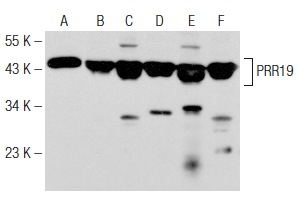
Western blot analysis of PRR19 expression in 293T (A), Hep G2 (B), Sol8 (C), L8 (D) and LADMAC (E) whole cell lysates and mouse skeletal muscle tissue extract (F).| Product Name | PRR19 Antibody (T-16) |
|---|---|
| Antibody Type | Primary Antibodies |
| Antigen Alias | epitope mapping within an internal region of PRR19 of human origin |
| Modification Notes | Consisting of around 63 million bases with over 1,400 genes, chromosome 19 makes up over 2% of human genomic DNA. Chromosome 19 includes a diversity of interesting genes and is recognized for having the greatest gene density of the human chromosomes. It is the genetic home for a number of immunoglobulin superfamily members including the killer cell and leukocyte Ig-like receptors, a number of ICAMs, the CEACAM and PSG family, and Fcå receptors. Key genes for eye color and hair color also map to chromosome 19. Peutz-Jeghers syndrome, spinocerebellar ataxia type 6, the stroke disorder CADASIL, hypercholesterolemia and insulin-dependent diabetes have been linked to chromosome 19. Translocations with chromosome 19 and chromosome 14 can be seen in some lymphoproliferative disorders and typically involve the proto-oncogene BCL3. |
| Clonality | Polyclonal |
|---|---|
| Isotype | IgG |
| Host Species | Rabbit |
| Tested Applications | WBIPIFELISA |
| recommended for detection of PRR19 of mouse, rat and human origin by WB, IP, IF and ELISA non cross-reactive with other PRR family members also reactive with additional species, including equine, canine, bovine and porcine: |
|
| Species Reactivity | HumanMouseRat |
| Concentration | 1mg/ml |
| Purification | Affinity purified |
| Alternative Names | epitope mapping within an internal region of PRR19 of human origin |
|---|---|
| Tissue Specificity | epitope mapping within an internal region of PRR19 of human origin |
| Entrez Gene | 284338 |
|---|
Application
Western blot analysis of PRR19 expression in 293T (A), Hep G2 (B), Sol8 (C), L8 (D) and LADMAC (E) whole cell lysates and mouse skeletal muscle tissue extract (F).| Application Notes | recommended for detection of PRR19 of mouse, rat and human origin by WB, IP, IF and ELISA non cross-reactive with other PRR family members also reactive with additional species, including equine, canine, bovine and porcine: |
|---|
| Form | Liquid |
|---|---|
| Storage Instructions | For short-term storage, store at 4° C. For long-term storage, aliquot and store at -20ºC or below. Avoid multiple freeze-thaw cycles. |
| Storage Buffer | phosphate buffered saline , pH 7.4, 150mM NaCl, 0.02% sodium azide and 50% glycerol. |


