Application
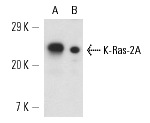
Western blot analysis of K-Ras-2A expression in KNRK (A) and Jurkat (B) whole cell lysates.Application
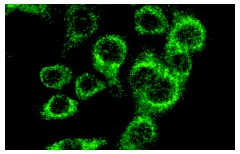
Immunofluorescence staining of methanol-fixed Sol8 cells showing cytoplasmic localization.| Product Name | K-Ras-2A Antibody (C-17) |
|---|---|
| Antibody Type | Primary Antibodies |
| Antigen Alias | epitope mapping at the C-terminus of K-Ras-2A of human origin |
| Modification Notes | The mammalian Ras (also designated v-Ha-Ras, Harvey rat sarcoma viral oncogene homolog, HRAS1, K-Ras, N-Ras, RASH1 or c-bas/has) gene family consists of the Harvey and Kirsten Ras genes (c-H-Ras1 and c-K-Ras2), an inactive pseudogene of each (c-H-Ras2 and c-K-Ras1) and the N-Ras gene. The three Ras oncogenes, H-Ras, K-Ras and N-Ras, encode proteins with GTP/GDP binding and GTPase activity. Ras proteins alternate between an inactive form bound to GDP and an active form bound to GTP, activated by a guanine nucleotide-exchange factor (GEF) and inactivated by a GTPase-activating protein (GAP). Ras nomenclature originates from the characterization of human DNA sequences homologous to cloned DNA fragments containing oncogenic sequences of a type C mammalian retrovirus, the Harvey strain of murine sarcoma virus (HaMSV), derived from the rat. Under normal conditions, Ras family members influence cell growth and differentiation events in a subcellular membrane compartmentalization-based signaling system. Oncogenic Ras can deregulate processes that control both cell proliferation and apoptosis. The Ras superfamily of GTP hydrolysis-coupled signal transduction relay proteins can be subclassified into Ras, Rho, Rab and ARF families. |
| Clonality | Polyclonal |
|---|---|
| Isotype | IgG |
| Host Species | Rabbit |
| Tested Applications | WBIPIFELISA |
| recommended for detection of K-Ras-2A p21 of mouse, rat and human origin by WB, IP, IF and ELISA also reactive with additional species, including equine and canine: |
|
| Species Reactivity | HumanMouseRat |
| Concentration | 1mg/ml |
| Purification | Affinity purified |
| Alternative Names | epitope mapping at the C-terminus of K-Ras-2A of human origin |
|---|---|
| Tissue Specificity | epitope mapping at the C-terminus of K-Ras-2A of human origin |
| Entrez Gene | 3845 |
|---|
Application
Western blot analysis of K-Ras-2A expression in KNRK (A) and Jurkat (B) whole cell lysates.
Application
Immunofluorescence staining of methanol-fixed Sol8 cells showing cytoplasmic localization.| Application Notes | recommended for detection of K-Ras-2A p21 of mouse, rat and human origin by WB, IP, IF and ELISA also reactive with additional species, including equine and canine: |
|---|
| Form | Liquid |
|---|---|
| Storage Instructions | For short-term storage, store at 4° C. For long-term storage, aliquot and store at -20ºC or below. Avoid multiple freeze-thaw cycles. |
| Storage Buffer | phosphate buffered saline , pH 7.4, 150mM NaCl, 0.02% sodium azide and 50% glycerol. |


