Application
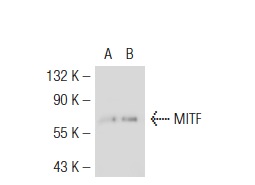
Western blot analysis of MITF expression in non-transfected: (A) and human MITF transfected: (B) 293T whole cell lysates.| Product Name | MITF Antibody (H-50) |
|---|---|
| Antibody Type | Primary Antibodies |
| Antigen Alias | epitope corresponding to amino acids 431-480 mapping at the C-terminus of MITF of human origin |
| Modification Notes | MITF (microphthalmia-associated transcription factor) is a melanocytic nuclear protein that contains basic helix-loop-helix (HLH) and leucine zipper (LZ) domains. These protein motifs are frequently observed in other transcription factors and are particularly common to members of the Myc family. MITF can directly associate with DNA as a homodimer and is required for the development and differentiation of melanocytes. Its expression is upregulated by cAMP and cAMP-dependent pathways. MITF activates several different gene promoters by binding to their E-boxes. Tyrosinase, TRP1 and TRP2 are pigment synthesis genes activated by MITF. When MITF is phosphorylated on Ser73 (via the MAPK pathway), it associates with co-activators of the p300/CBP family and enhances transcription. MITF has several isoforms including MITF-M which is specifically expressed in melanocytes. In MITF-deficient mice there is a complete absence of melanocytes. |
| Clonality | Polyclonal |
|---|---|
| Isotype | IgG |
| Host Species | Rabbit |
| Tested Applications | WBIPIFELISAGSChIP |
| recommended for detection of MITF of mouse, rat and human origin by WB, IP, IF and ELISA also reactive with additional species, including equine, canine, bovine and porcine: |
|
| Species Reactivity | HumanMouseRat |
| Concentration | 1mg/ml |
| Purification | Affinity purified |
| Alternative Names | epitope corresponding to amino acids 431-480 mapping at the C-terminus of MITF of human origin |
|---|---|
| Tissue Specificity | epitope corresponding to amino acids 431-480 mapping at the C-terminus of MITF of human origin |
| Entrez Gene | 4286 |
|---|
Application
Western blot analysis of MITF expression in non-transfected: (A) and human MITF transfected: (B) 293T whole cell lysates.| Application Notes | recommended for detection of MITF of mouse, rat and human origin by WB, IP, IF and ELISA also reactive with additional species, including equine, canine, bovine and porcine: |
|---|
| Form | Liquid |
|---|---|
| Storage Instructions | For short-term storage, store at 4° C. For long-term storage, aliquot and store at -20ºC or below. Avoid multiple freeze-thaw cycles. |
| Storage Buffer | phosphate buffered saline , pH 7.4, 150mM NaCl, 0.02% sodium azide and 50% glycerol. |


