Application
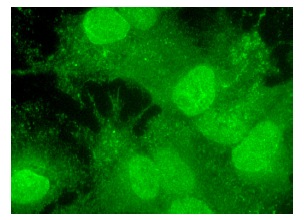
Immunofluorescence staining of formalin-fixed Hep G2 cells showing membrane and nuclear localization.| Product Name | CD39L4 Antibody (H-79) |
|---|---|
| Antibody Type | Primary Antibodies |
| Antigen Alias | epitope corresponding to amino acids 251-329 mapping within an internal region of CD39L4 of human origin |
| Modification Notes | CD39, also known as ectonucleoside triphosphate diphosphohydrolase 1 (ENP1), is an integral membrane glycoprotein that acts as an extracellular nucleotide-hydrolyzing enzyme. Characteristically, CD39 and other members of the ecto-ATPase family contain apyrase-conserved regions and function to mediate nucleotide catabolism. CD39L4, also known as ENTPD5 (ectonucleoside triphosphate diphosphohydrolase 5), is a 428 amino acid protein that is similar to CD39 and localizes to the lumen of the endoplasmic reticulum (ER). Highly expressed in colon, testis, kidney, liver and prostate, CD39L4 is thought to promote reglycosylation reactions that are involved in the folding of glycoproteins and in quality control events in the ER. Like other members of the ecto-ATPase family, CD39L4 contains four apyrase-conserved regions and is catalytically activated by calcium and magnesium. Overexpression of CD39L4 is implicated in the development of breast, testicular and prostate cancer, suggesting that CD39L4 may be a proto-oncogene involved in carcinogenesis. |
| Clonality | Polyclonal |
|---|---|
| Isotype | IgG |
| Host Species | Rabbit |
| Tested Applications | WBIPIFELISA |
| recommended for detection of CD39L4 of mouse, rat and human origin by WB, IP, IF and ELISA also reactive with additional species, including equine, canine, bovine and porcine: |
|
| Species Reactivity | HumanMouseRat |
| Concentration | 1mg/ml |
| Purification | Affinity purified |
| Alternative Names | epitope corresponding to amino acids 251-329 mapping within an internal region of CD39L4 of human origin |
|---|---|
| Tissue Specificity | epitope corresponding to amino acids 251-329 mapping within an internal region of CD39L4 of human origin |
Application
Immunofluorescence staining of formalin-fixed Hep G2 cells showing membrane and nuclear localization.| Application Notes | recommended for detection of CD39L4 of mouse, rat and human origin by WB, IP, IF and ELISA also reactive with additional species, including equine, canine, bovine and porcine: |
|---|
| Form | Liquid |
|---|---|
| Storage Instructions | For short-term storage, store at 4° C. For long-term storage, aliquot and store at -20ºC or below. Avoid multiple freeze-thaw cycles. |
| Storage Buffer | phosphate buffered saline , pH 7.4, 150mM NaCl, 0.02% sodium azide and 50% glycerol. |


