Application
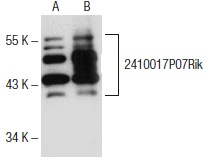
Western blot analysis of 2410017P07Rik expression in non-transfected: (A) and mouse 2410017P07Rik transfected: (B) 293T whole cell lysates.| Product Name | C6orf182 Antibody (E-14) |
|---|---|
| Antibody Type | Primary Antibodies |
| Antigen Alias | epitope mapping near the N-terminus of C6orf182 of human origin |
| Modification Notes | Making up nearly 6% of the human genome, chromosome 6 contains around 1,200 genes within 170 million base pairs of sequence. Deletion of a portion of the q arm of chromosome 6 is associated with early onset intestinal cancer suggesting the presence of a cancer susceptibility locus. Porphyria cutanea tarda is associated with chromosome 6 through the HFE gene which, when mutated, predisposes an individual to developing this porphyria. Notably, the PARK2 gene, which is associated with Parkinson's disease, and the genes encoding the major histocompatiblity complex proteins, which are key molecular components of the immune system and determine predisposition to rheumatic diseases, are also located on chromosome 6. Stickler syndrome, 21-hydroxylase deficiency and maple syrup urine disease are also associated with genes on chromosome 6. A bipolar disorder susceptibility locus has been identified on the q arm of chromosome 6. The C6orf182 gene product has been provisionally designated C6orf182 pending further characterization. |
| Clonality | Polyclonal |
|---|---|
| Isotype | IgG |
| Host Species | Rabbit |
| Tested Applications | WBIPIFELISA |
| recommended for detection of C6orf182 of human origin, 2410017P07Rik of mouse origin and the corresponding rat homolog by WB, IP, IF and ELISA non cross-reactive with other C6orf family members: |
|
| Species Reactivity | HumanMouseRat |
| Concentration | 1mg/ml |
| Purification | Affinity purified |
| Alternative Names | epitope mapping near the N-terminus of C6orf182 of human origin |
|---|---|
| Tissue Specificity | epitope mapping near the N-terminus of C6orf182 of human origin |
| Entrez Gene | 285753 |
|---|
Application
Western blot analysis of 2410017P07Rik expression in non-transfected: (A) and mouse 2410017P07Rik transfected: (B) 293T whole cell lysates.| Application Notes | recommended for detection of C6orf182 of human origin, 2410017P07Rik of mouse origin and the corresponding rat homolog by WB, IP, IF and ELISA non cross-reactive with other C6orf family members: |
|---|
| Form | Liquid |
|---|---|
| Storage Instructions | For short-term storage, store at 4° C. For long-term storage, aliquot and store at -20ºC or below. Avoid multiple freeze-thaw cycles. |
| Storage Buffer | phosphate buffered saline , pH 7.4, 150mM NaCl, 0.02% sodium azide and 50% glycerol. |


