Application
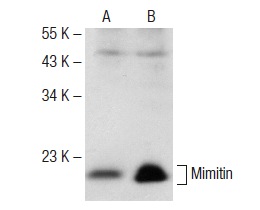
Western blot analysis of Mimitin expression in rat pituitary tissue extract (A) and A-673 whole cell lysate (B).| Product Name | Mimitin Antibody (FL-169) |
|---|---|
| Antibody Type | Primary Antibodies |
| Antigen Alias | epitope corresponding to amino acids 1-169 representing full length Mimitin of human origin |
| Modification Notes | The Myc family represents nuclear transcription factors that contribute significantly to cellular proliferation, differentiation, apoptosis and transformation. The Myc family of cellular oncogenes includes c-Myc, N-Myc, L-Myc, S-Myc and B-Myc. Myc-induced mitochondrial protein (MMTN), also designated Mimitin, localizes exclusively to the mitochondrion. Mimitin belongs to the complex I NDUFA12 subunit family of proteins and is highly expressed in esophageal squamous cell carcinoma (ESCC) cells. Mimitin plays an important role in Myc-dependent cell proliferation. It is a direct transcriptional target of c-Myc, which mediates gene repression by inhibiting the DNA binding protein Miz-1 and inhibiting cell growth. However, Mimitin expression in ESCC has no affect on the histopathological stage or grade of the cancer. |
| Clonality | Polyclonal |
|---|---|
| Isotype | IgG |
| Host Species | Rabbit |
| Tested Applications | WBIPIFELISA |
| recommended for detection of Mimitin (Myc-induced mitochondrial protein) of mouse, rat and human origin by WB, IP, IF and ELISA also reactive with additional species, including equine: |
|
| Species Reactivity | HumanMouseRat |
| Concentration | 1mg/ml |
| Purification | Affinity purified |
| Alternative Names | epitope corresponding to amino acids 1-169 representing full length Mimitin of human origin |
|---|---|
| Tissue Specificity | epitope corresponding to amino acids 1-169 representing full length Mimitin of human origin |
Application
Western blot analysis of Mimitin expression in rat pituitary tissue extract (A) and A-673 whole cell lysate (B).| Application Notes | recommended for detection of Mimitin (Myc-induced mitochondrial protein) of mouse, rat and human origin by WB, IP, IF and ELISA also reactive with additional species, including equine: |
|---|
| Form | Liquid |
|---|---|
| Storage Instructions | For short-term storage, store at 4° C. For long-term storage, aliquot and store at -20ºC or below. Avoid multiple freeze-thaw cycles. |
| Storage Buffer | phosphate buffered saline , pH 7.4, 150mM NaCl, 0.02% sodium azide and 50% glycerol. |


