Application
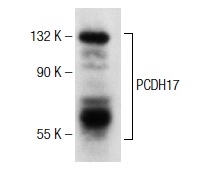
Western blot analysis of PCDH17 expression in HL-60 whole cell lysate.| Product Name | PCDH17 Antibody (H-130) |
|---|---|
| Antibody Type | Primary Antibodies |
| Antigen Alias | epitope corresponding to amino acids 578-707 mapping within an N-terminal extracellular domain of PCDH17 of human origin |
| Modification Notes | Protocadherins are a large family of cadherin-like cell adhesion proteins that are involved in the establishment and maintenance of neuronal connections in the brain. There are three protocadherin gene clusters, designated alpha, beta and gamma, all of which contain multiple tandemly arranged genes. PCDH17 (protocadherin 17), also known as PCDH68 or PCH68, is a 1,159 amino acid single-pass type I membrane protein that contains six cadherin domains. Expressed as multiple alternatively spliced isoforms, PCDH17 is thought to function as a calcium-dependent cell adhesion protein that may play a role in establishing cell-cell connections within brain tissue. The gene encoding PCDH17 maps to human chromosome 13, which houses over 400 genes, such as BRCA2 and RB1, and comprises nearly 4% of the human genome. |
| Clonality | Polyclonal |
|---|---|
| Isotype | IgG |
| Host Species | Rabbit |
| Tested Applications | WBIPIFELISA |
| recommended for detection of PCDH17 of mouse, rat and human origin by WB, IP, IF and ELISA also reactive with additional species, including equine, canine, bovine and porcine: |
|
| Species Reactivity | HumanMouseRat |
| Concentration | 1mg/ml |
| Purification | Affinity purified |
| Alternative Names | epitope corresponding to amino acids 578-707 mapping within an N-terminal extracellular domain of PCDH17 of human origin |
|---|---|
| Tissue Specificity | epitope corresponding to amino acids 578-707 mapping within an N-terminal extracellular domain of PCDH17 of human origin |
| Entrez Gene | 27253 |
|---|
Application
Western blot analysis of PCDH17 expression in HL-60 whole cell lysate.| Application Notes | recommended for detection of PCDH17 of mouse, rat and human origin by WB, IP, IF and ELISA also reactive with additional species, including equine, canine, bovine and porcine: |
|---|
| Form | Liquid |
|---|---|
| Storage Instructions | For short-term storage, store at 4° C. For long-term storage, aliquot and store at -20ºC or below. Avoid multiple freeze-thaw cycles. |
| Storage Buffer | phosphate buffered saline , pH 7.4, 150mM NaCl, 0.02% sodium azide and 50% glycerol. |


