Application
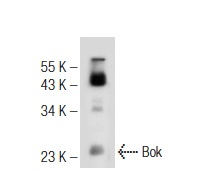
Western blot analysis of Bok expression in HT-1080 whole cell lysate.| Product Name | Bok Antibody (H-151) |
|---|---|
| Antibody Type | Primary Antibodies |
| Antigen Alias | epitope corresponding to amino acids 61-212 of Bok (Bcl-2-related ovarian killer) of human origin |
| Modification Notes | Members of the Bcl-2 family of proteins interact to regulate apoptosis, a process by which multicellular organisms eliminate superflous cells. Various homodimers and heterodimers formed by proteins in this family either promote or inhibit apoptosis. Bcl-2 blocks cell death following a variety of stimuli and confers a death-sparing effect on certain hematopoietic cell lines following growth factor withdrawal. Bok, or Bcl-2 related ovarian killer, is highly expressed in ovary, testis, uterus and mammary glands. Bok induces apoptosis in cells, which is suppressible by anti-apoptotic human Bcl-2 family proteins. Bok targets mitochondria and triggers cytochrome c release through a caspase- independent mechanism. Bok contains the conserved Bcl-2 homology (BH) domains 1, 2 and 3, but lacks the BH4 domain. Bok selectively heterodimerizes with some anti-apoptotic members of the Bcl-2 protein family, including Mcl-1 and Bfl-1, but it does not appear to interact with Bcl-2, Bcl-x L and Bcl-w. |
| Clonality | Polyclonal |
|---|---|
| Isotype | IgG |
| Host Species | Rabbit |
| Tested Applications | WBIPIFELISA |
| recommended for detection of Bok of mouse, rat and human origin by WB, IP, IF and ELISA also reactive with additional species, including bovine: |
|
| Species Reactivity | HumanMouseRat |
| Concentration | 1mg/ml |
| Purification | Affinity purified |
| Alternative Names | epitope corresponding to amino acids 61-212 of Bok (Bcl-2-related ovarian killer) of human origin |
|---|---|
| Tissue Specificity | epitope corresponding to amino acids 61-212 of Bok (Bcl-2-related ovarian killer) of human origin |
| Entrez Gene | 666 |
|---|
Application
Western blot analysis of Bok expression in HT-1080 whole cell lysate.| Application Notes | recommended for detection of Bok of mouse, rat and human origin by WB, IP, IF and ELISA also reactive with additional species, including bovine: |
|---|
| Form | Liquid |
|---|---|
| Storage Instructions | For short-term storage, store at 4° C. For long-term storage, aliquot and store at -20ºC or below. Avoid multiple freeze-thaw cycles. |
| Storage Buffer | phosphate buffered saline , pH 7.4, 150mM NaCl, 0.02% sodium azide and 50% glycerol. |


