Application
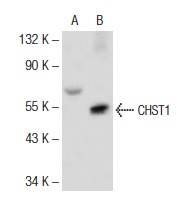
Western blot analysis of CHST1 expression in non-transfected: (A) and human CHST1 transfected: (B) 293T whole cell lysates.| Product Name | CHST1 Antibody (H-107) |
|---|---|
| Antibody Type | Primary Antibodies |
| Antigen Alias | epitope corresponding to amino acids 305-411 mapping at the C-terminus of CHST1 of human origin |
| Modification Notes | Sulfotransferase enzymes catalyze the sulfate conjugation of many hormones, neurotransmitters, drugs, and xenobiotic compounds. These enzymes differ in their tissue distributions and substrate specificities, although the gene structure (number and length of exons) is similar among family members. Carbohydrate sulfotransferase 1 (CHST1), also referred to as KSGal6ST or KSST, is a keratan sulfate sulfotransferase. It is predominantly expressed in brain and skeletal muscle and localizes to the trans-Golgi network. CHST1 is responsible for mediating the sulfation of keratan in the cornea, which is important in maintaining corneal transparency. In particular, CHST1 catalyzes the transfer of sulfate groups from 3’-phosphoadenosine 5’-phosphosulfate to position six of internal or terminal galactose residues (preferentially the residues adjacent to sulfated GlcNAc) on growing keratan sulfate chains. CHST1 also contributes to the generation of L-selectin ligands. Mutations in the CHST1 gene may play a role in macular corneal dystrophy (MCD). |
| Clonality | Polyclonal |
|---|---|
| Isotype | IgG |
| Host Species | Rabbit |
| Tested Applications | WBIPIFELISA |
| recommended for detection of CHST1 of mouse, rat and human origin by WB, IP, IF and ELISA also reactive with additional species, including canine, bovine and porcine: |
|
| Species Reactivity | HumanMouseRat |
| Concentration | 1mg/ml |
| Purification | Affinity purified |
| Alternative Names | epitope corresponding to amino acids 305-411 mapping at the C-terminus of CHST1 of human origin |
|---|---|
| Tissue Specificity | epitope corresponding to amino acids 305-411 mapping at the C-terminus of CHST1 of human origin |
| Entrez Gene | 8534 |
|---|
Application
Western blot analysis of CHST1 expression in non-transfected: (A) and human CHST1 transfected: (B) 293T whole cell lysates.| Application Notes | recommended for detection of CHST1 of mouse, rat and human origin by WB, IP, IF and ELISA also reactive with additional species, including canine, bovine and porcine: |
|---|
| Form | Liquid |
|---|---|
| Storage Instructions | For short-term storage, store at 4° C. For long-term storage, aliquot and store at -20ºC or below. Avoid multiple freeze-thaw cycles. |
| Storage Buffer | phosphate buffered saline , pH 7.4, 150mM NaCl, 0.02% sodium azide and 50% glycerol. |


