Application
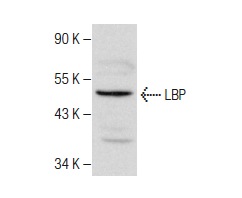
Western blot analysis of LBP expression in human liver tissue extract.| Product Name | LBP Antibody (H-117) |
|---|---|
| Antibody Type | Primary Antibodies |
| Antigen Alias | epitope corresponding to amino acids 25-141 mapping near the N-terminus of LBP of human origin |
| Modification Notes | Lipopolysaccharide-binding protein (LBP) is essential for the rapid induction of an inflammatory response in the presence of small amounts of lipopolysaccharide (LPS) or Gram-negative bacteria. During Gram-negative bacterial infections, membrane associated LPS, the principal stimulator of the innate immune system, is bound by the acute-phase reactant LBP. Secretion of LBP sensitizes the immune system to endotoxin, enhances the neutralization of endotoxin by high density lipoprotein and, at elevated levels, protects against sepsis. The human LBP sequence consists of a 25-residue signal sequence followed by a 452-residue mature protein containing four cysteine residues and five putative glycosylation sites. During inflammation, LBP is secreted by hepatic cells and intestinal epithelial cells. LPS bound to LBP through lipid A moieties is transferred to LPS receptors (CD14) on the surface of macrophages or to high-density lipoprotein (HDL) particles. |
| Clonality | Polyclonal |
|---|---|
| Isotype | IgG |
| Host Species | Rabbit |
| Tested Applications | WBIPIFELISA |
| recommended for detection of LBP of human origin by WB, IP, IF and ELISA: |
|
| Species Reactivity | HumanMouseRat |
| Concentration | 1mg/ml |
| Purification | Affinity purified |
| Alternative Names | epitope corresponding to amino acids 25-141 mapping near the N-terminus of LBP of human origin |
|---|---|
| Tissue Specificity | epitope corresponding to amino acids 25-141 mapping near the N-terminus of LBP of human origin |
| Entrez Gene | 3929 |
|---|
Application
Western blot analysis of LBP expression in human liver tissue extract.| Application Notes | recommended for detection of LBP of human origin by WB, IP, IF and ELISA: |
|---|
| Form | Liquid |
|---|---|
| Storage Instructions | For short-term storage, store at 4° C. For long-term storage, aliquot and store at -20ºC or below. Avoid multiple freeze-thaw cycles. |
| Storage Buffer | phosphate buffered saline , pH 7.4, 150mM NaCl, 0.02% sodium azide and 50% glycerol. |


