Application
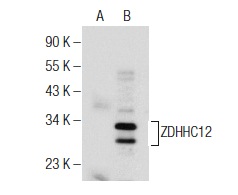
Western blot analysis of ZDHHC12 expression in non-transfected: (A) and mouse ZDHHC12 transfected: (B) 293T whole cell lysates.| Product Name | ZDHHC12 Antibody (C-14) |
|---|---|
| Antibody Type | Primary Antibodies |
| Antigen Alias | epitope mapping near the C-terminus of ZDHHC12 of human origin |
| Modification Notes | Zinc-finger proteins contain DNA-binding domains and have a wide variety of functions, most of which encompass some form of transcriptional activation or repression. ZDHHC12 (zinc finger, DHHC domain containing 12), also known as ZNF400, is a 267 amino acid multi-pass membrane protein that contains one DHHC-type zinc finger and is thought to function as a palmitoyltransferase, catalyzing the transformation of palmitoyl-CoA and a cysteine-conjugated protein to a S-palmitoyl protein and free CoA. Three isoforms exist due to alternative splicing events. The gene encoding ZDHHC12 maps to human chromosome 9, which consists of about 145 million bases and 4% of the human genome and encodes nearly 900 genes. Chromosome 9 is considered to play a role in gender determination, deletion of the distal portion of 9p can lead to development of male to female sex reversal, the phenotype of a female with a male X,Y genotype. |
| Clonality | Polyclonal |
|---|---|
| Isotype | IgG |
| Host Species | Rabbit |
| Tested Applications | WBIPIFELISA |
| recommended for detection of ZDHHC12 of human and, to a lesser extent, mouse and rat origin by WB, IP, IF and ELISA non cross-reactive with other ZDHHC family members also reactive with additional species, including equine, bovine and porcine: |
|
| Species Reactivity | HumanMouseRat |
| Concentration | 1mg/ml |
| Purification | Affinity purified |
| Alternative Names | epitope mapping near the C-terminus of ZDHHC12 of human origin |
|---|---|
| Tissue Specificity | epitope mapping near the C-terminus of ZDHHC12 of human origin |
| Entrez Gene | 84885 |
|---|
Application
Western blot analysis of ZDHHC12 expression in non-transfected: (A) and mouse ZDHHC12 transfected: (B) 293T whole cell lysates.| Application Notes | recommended for detection of ZDHHC12 of human and, to a lesser extent, mouse and rat origin by WB, IP, IF and ELISA non cross-reactive with other ZDHHC family members also reactive with additional species, including equine, bovine and porcine: |
|---|
| Form | Liquid |
|---|---|
| Storage Instructions | For short-term storage, store at 4° C. For long-term storage, aliquot and store at -20ºC or below. Avoid multiple freeze-thaw cycles. |
| Storage Buffer | phosphate buffered saline , pH 7.4, 150mM NaCl, 0.02% sodium azide and 50% glycerol. |


