Application
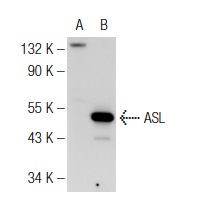
Western blot analysis of ASL expression in non-transfected: (A) and human ASL transfected: (B) 293 whole cell lysates.| Product Name | ASL Antibody (H-300) |
|---|---|
| Antibody Type | Primary Antibodies |
| Antigen Alias | epitope corresponding to amino acids 1-300 mapping at the N-terminus of ASL of human origin |
| Modification Notes | ASL (argininosuccinate lyase), also known as ASAL or arginosuccinase, is a member of the lyase 1 family of proteins and is predominantly expressed in the liver. Localizing to the cytoplasm and existing as a homotetramer, ASL catalyzes the hydrolytic cleavage of argininosuccinic acid (ASA) to fumarate and arginine, an essential step of the urea cycle which is crucial for the detoxification of ammonia. This reaction is also involved in the biosynthesis of arginine. In addition, ASL shares high sequence homology with the avian and reptilian eye lens protein, d-crystallin. Mutations in the gene encoding ASL leads to an accumulation of ASA in body fluids and results in Arginosuc-cinic aciduria (ASAuria), an autosomal recessive disorder that is characterized by hyperammonemia, liver enlargement, convulsions, physical and mental retardation, episodic unconsciousness and dry and brittle hair showing trich-orrhexis nodosa (weak points or nodes in the hair shaft). |
| Clonality | Polyclonal |
|---|---|
| Isotype | IgG |
| Host Species | Rabbit |
| Tested Applications | WBIPIFELISA |
| recommended for detection of ASL of mouse, rat and human origin by WB, IP, IF and ELISA also reactive with additional species, including equine, canine, bovine and porcine: |
|
| Species Reactivity | HumanMouseRat |
| Concentration | 1mg/ml |
| Purification | Affinity purified |
| Alternative Names | epitope corresponding to amino acids 1-300 mapping at the N-terminus of ASL of human origin |
|---|---|
| Tissue Specificity | epitope corresponding to amino acids 1-300 mapping at the N-terminus of ASL of human origin |
| Entrez Gene | 435 |
|---|
Application
Western blot analysis of ASL expression in non-transfected: (A) and human ASL transfected: (B) 293 whole cell lysates.| Application Notes | recommended for detection of ASL of mouse, rat and human origin by WB, IP, IF and ELISA also reactive with additional species, including equine, canine, bovine and porcine: |
|---|
| Form | Liquid |
|---|---|
| Storage Instructions | For short-term storage, store at 4° C. For long-term storage, aliquot and store at -20ºC or below. Avoid multiple freeze-thaw cycles. |
| Storage Buffer | phosphate buffered saline , pH 7.4, 150mM NaCl, 0.02% sodium azide and 50% glycerol. |


