Application
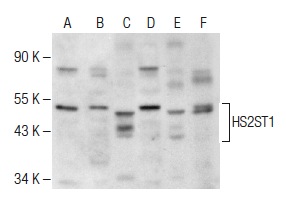
Western blot analysis of HS2ST1 expression in SK-N-MC (A), HeLa (B), Ramos (C), Hep G2 (D) and CCRF-CEM (E) whole cell lysates and mouse liver tissue extract (F).| Product Name | HS2ST1 Antibody (H-170) |
|---|---|
| Antibody Type | Primary Antibodies |
| Antigen Alias | epitope corresponding to amino acids 1-170 mapping at the N-terminus of HS2ST1 of human origin |
| Modification Notes | Heparan sulfate structures, which are responsible for executing multiple biologic activities, are generated and regulated by heparan sulfate biosynthetic enzymes. HS2ST1 (heparan sulfate 2-O-sulfotransferase 1), also known as HS2ST, is a 356 amino acid single-pass type II membrane protein that localizes to the golgi apparatus and belongs to the sulfotransferase 3 family. Expressed as multiple alternatively spliced isoforms, HS2ST1 functions to catalyze the transfer of sulfate groups to hexuronic acid residues within maturing heparan sulfate (HS), an event which is crucial for proper HS-related ligand binding and signaling processes. HS2ST1 is subject to post-translational N-glycosylation and, in addition to its role in HS function, may be involved in proper kidney formation. |
| Clonality | Polyclonal |
|---|---|
| Isotype | IgG |
| Host Species | Rabbit |
| Tested Applications | WBIPIFELISA |
| recommended for detection of HS2ST1 of mouse, rat and human origin by WB, IP, IF and ELISA also reactive with additional species, including equine, canine, porcine and avian: |
|
| Species Reactivity | HumanMouseRat |
| Concentration | 1mg/ml |
| Purification | Affinity purified |
| Alternative Names | epitope corresponding to amino acids 1-170 mapping at the N-terminus of HS2ST1 of human origin |
|---|---|
| Tissue Specificity | epitope corresponding to amino acids 1-170 mapping at the N-terminus of HS2ST1 of human origin |
| Entrez Gene | 9653 |
|---|
Application
Western blot analysis of HS2ST1 expression in SK-N-MC (A), HeLa (B), Ramos (C), Hep G2 (D) and CCRF-CEM (E) whole cell lysates and mouse liver tissue extract (F).| Application Notes | recommended for detection of HS2ST1 of mouse, rat and human origin by WB, IP, IF and ELISA also reactive with additional species, including equine, canine, porcine and avian: |
|---|
| Form | Liquid |
|---|---|
| Storage Instructions | For short-term storage, store at 4° C. For long-term storage, aliquot and store at -20ºC or below. Avoid multiple freeze-thaw cycles. |
| Storage Buffer | phosphate buffered saline , pH 7.4, 150mM NaCl, 0.02% sodium azide and 50% glycerol. |


