Application
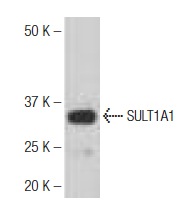
Western blot analysis of SULT1A1 expression in mouse kidney tissue extract.| Product Name | SULT1A1 Antibody (Z-21) |
|---|---|
| Antibody Type | Primary Antibodies |
| Antigen Alias | recommended for detection of SULT1A1 of mouse and human origin by WB, IP and ELISA |
| Modification Notes | The soluble sulfotransferases contribute to the elimination of xenobiotics, the activation of procarcinogens and the regulation of hormones by catalyzing the sulfate conjugation of these substances. Members of the three groups comprising this superfamily (namely SULT1, SULT2 and SULT3) show selectivity to certain substrate compounds. SULT1A1 (sulfotransferase family, cytosolic, 1A, phenol-preferring, member 1), also known as STP or STP1, is a 295 amino acid protein that localizes to the cytoplasm and belongs to the sulfotransferase family. Functioning as a homodimer that is expressed in brain, liver, skin and lung tissue, SULT1A1 catalyzes the sulfate conjugation of catecholamines, phenolic drugs and neurotransmitters and, via this catalytic activity, plays a role in the elimination of a variety of compounds from the body. Additionally, SULT1A1 may be involved in the activation of carcinogenic N-hydroxyarylamines, indicating a possible role in carcinogenesis. |
| Clonality | Polyclonal |
|---|---|
| Isotype | IgG |
| Host Species | Rabbit |
| Tested Applications | WBIPELISA |
| WB:1:500~1:2000 IP:1:100~1:500 Notes:Optimal dilutions/concentrations should be determined by the researcher. |
|
| Species Reactivity | HumanMouseRat |
| Concentration | 1mg/ml |
| Purification | Affinity purified |
| Alternative Names | recommended for detection of SULT1A1 of mouse and human origin by WB IP and ELISA |
|---|---|
| Tissue Specificity | recommended for detection of SULT1A1 of mouse and human origin by WB, IP and ELISA |
| Entrez Gene | 6817 |
|---|
Application
Western blot analysis of SULT1A1 expression in mouse kidney tissue extract.| Application Notes | WB:1:500~1:2000 IP:1:100~1:500 Notes:Optimal dilutions/concentrations should be determined by the researcher. |
|---|
| Form | Liquid |
|---|---|
| Storage Instructions | For short-term storage, store at 4° C. For long-term storage, aliquot and store at -20ºC or below. Avoid multiple freeze-thaw cycles. |
| Storage Buffer | phosphate buffered saline , pH 7.4, 150mM NaCl, 0.02% sodium azide and 50% glycerol. |


