Application
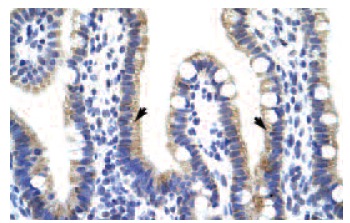
Immunoperoxidase staining of formalin-fixed, paraffin-embedded human intestine tissue showing cytoplasmic localization.| Product Name | EXOSC10 Antibody (A-24) |
|---|---|
| Antibody Type | Primary Antibodies |
| Antigen Alias | recommended for detection of EXOSC10 of human origin by WB, IP, IF, IHC(P) and ELISA |
| Modification Notes | The exosome is a multi-subunit complex composed of several highly conserved proteins, some of which are 3’ to 5’ exoribonucleases. The complex is involved in a variety of cellular processes and is responsible for degrading unstable mRNAs that contain AU-rich (ARE) elements in their untranslated 3’ region. EXOSC10, also known as PMSCL, PMSCL2, p2, p3, p4, RRP6, Rrp6p, PM-Scl, or PM/Scl-100, is an 885 amino acid protein that contains one HRDC domain and one 3’-5’ enonuclease domain. Localized to both the cytoplasm and the nucleus, EXOSC10 is part of the post-splicing exosome complex and is involved in mRNA surveillance, mRNA nuclear export and nonsense-mediated decay of mRNAs containing premature stop codons. Antibodies against EXOSC10 have been found in patients with scleroderma and/or polymyositis (chronic diseases of the skin and muscle, respectively), suggesting that EXOSC10 may be involved in the pathogenesis of these diseases. Two isoforms of EXOSC10 exist due to alternative splicing events. |
| Clonality | Polyclonal |
|---|---|
| Isotype | IgG |
| Host Species | Rabbit |
| Tested Applications | WBIPIFIHCELISA |
| WB:1:500~1:2000 IP:1:100~1:500 IF:1:200~1:500 IHC:1:50~1:200 Notes:Optimal dilutions/concentrations should be determined by the researcher. |
|
| Species Reactivity | HumanMouseRat |
| Concentration | 1mg/ml |
| Purification | Affinity purified |
| Alternative Names | recommended for detection of EXOSC10 of human origin by WB IP IF IHC(P) and ELISA |
|---|---|
| Tissue Specificity | recommended for detection of EXOSC10 of human origin by WB, IP, IF, IHC(P) and ELISA |
| Entrez Gene | 5394 |
|---|
Application
Immunoperoxidase staining of formalin-fixed, paraffin-embedded human intestine tissue showing cytoplasmic localization.| Application Notes | WB:1:500~1:2000 IP:1:100~1:500 IF:1:200~1:500 IHC:1:50~1:200 Notes:Optimal dilutions/concentrations should be determined by the researcher. |
|---|
| Form | Liquid |
|---|---|
| Storage Instructions | For short-term storage, store at 4° C. For long-term storage, aliquot and store at -20ºC or below. Avoid multiple freeze-thaw cycles. |
| Storage Buffer | phosphate buffered saline , pH 7.4, 150mM NaCl, 0.02% sodium azide and 50% glycerol. |


