Application
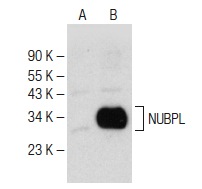
Western blot analysis of NUBPL expression in non-transfected: (A) and human NUBPL transfected: (B) 293T whole cell lysates.| Product Name | NUBPL Antibody (S-12) |
|---|---|
| Antibody Type | Primary Antibodies |
| Antigen Alias | epitope mapping within an internal region of NUBPL of human origin |
| Modification Notes | NUBPL (nucleotide-binding protein-like) is a 319 amino acid mitochondrial protein that belongs to the Mrp/NBP35 ATP-binding protein family and exists as two alternatively spliced isoforms. Required for the assembly of the mitochondrial membrane respiratory chain NADH dehydrogenase (complex I), NUBPL may deliver one or more Fe-S clusters to complex I subunits. With highest expression in liver and kidney, NUBPL is expressed at significant levels in small intestine and brain. Defects in NUBPL are a cause of mitochondrial complex I deficiency (MT-C1D), a disorder of the mitochondrial respiratory chain that causes a wide range of afflictions from lethal neonatal disease to adult-onset neurodegenerative disorders. Phenotypes include macrocephaly with progressive leukodystrophy, non-specific encephalopathy, cardiomyopathy, myopathy, liver disease, Leigh syndrome, Leber hereditary optic neuropathy and some forms of Parkinson disease. |
| Clonality | Polyclonal |
|---|---|
| Isotype | IgG |
| Host Species | Rabbit |
| Tested Applications | WBIPIFELISA |
| recommended for detection of NUBPL of mouse, rat and human origin by WB, IP, IF and ELISA non cross-reactive with NUBP1 or NUBP2 also reactive with additional species, including equine, canine, bovine and avian: |
|
| Species Reactivity | HumanMouseRat |
| Concentration | 1mg/ml |
| Purification | Affinity purified |
| Alternative Names | epitope mapping within an internal region of NUBPL of human origin |
|---|---|
| Tissue Specificity | epitope mapping within an internal region of NUBPL of human origin |
| Entrez Gene | 80224 |
|---|
Application
Western blot analysis of NUBPL expression in non-transfected: (A) and human NUBPL transfected: (B) 293T whole cell lysates.| Application Notes | recommended for detection of NUBPL of mouse, rat and human origin by WB, IP, IF and ELISA non cross-reactive with NUBP1 or NUBP2 also reactive with additional species, including equine, canine, bovine and avian: |
|---|
| Form | Liquid |
|---|---|
| Storage Instructions | For short-term storage, store at 4° C. For long-term storage, aliquot and store at -20ºC or below. Avoid multiple freeze-thaw cycles. |
| Storage Buffer | phosphate buffered saline , pH 7.4, 150mM NaCl, 0.02% sodium azide and 50% glycerol. |


