Application
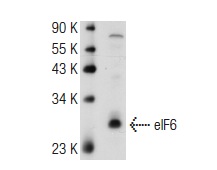
Western blot analysis of eIF6 expression in K-562 whole cell lysate.Application
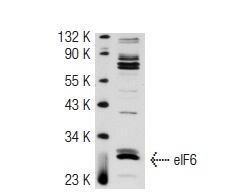
Western blot analysis of eIF6 expression in NIH/3T3 whole cell lysate.| Product Name | eIF6 Antibody (N-14) |
|---|---|
| Antibody Type | Primary Antibodies |
| Antigen Alias | epitope mapping at the N-terminus of eIF6 of human origin |
| Modification Notes | The initiation of protein synthesis in eukaryotic cells is regulated by interactions between protein initiation factors and RNA molecules. Eukaryotic initiation factors (eIFs) are utilized in a sequence of reactions that lead to 80S ribosomal assembly and, ultimately, translation. eIF6 (eukaryotic translation initiation factor 6) is also known as CAB, B(2)GCN homolog, p27(BBP) or B4 integrin interactor and is a 245 amino acid protein that is localized to the cytoplasm, as well as to the nucleolus within the nucleus. The eIF6 N-terminal and C-terminal subdomains are thought to contain important nucleolar localization sequences. eIF6 may be a regulator of ribosomal function and creation. eIF6 functions to bind and translocate the 60S ribosomal subunit from the nucleus to the cytoplasm, effectively preventing the 60S subunit from associating with the 40S subunit and inhibiting formation of the 80S initiation complex. The regulation of the formation of the 80S ribosomes also regulates transcription. Once translocated to the cytoplasm, the eIF6-60S ribosomal subunit complex is subject to phosphorylation via the RACK1/PKC pathway, an event that results in the dissociation of eIF6 from the 60S subunit. Upregulation of eIF6 is strongly associated with a variety of of cancers, such as ovarian cancer, suggesting that eIF6 may be involved in carcinogenesis. |
| Clonality | Polyclonal |
|---|---|
| Isotype | IgG |
| Host Species | Rabbit |
| Tested Applications | WBIPIFELISA |
| recommended for detection of eIF6 of mouse, rat and human origin by WB, IP, IF and ELISA also reactive with additional species, including equine, canine, bovine, porcine and avian: |
|
| Species Reactivity | HumanMouseRat |
| Concentration | 1mg/ml |
| Purification | Affinity purified |
| Alternative Names | epitope mapping at the N-terminus of eIF6 of human origin |
|---|---|
| Tissue Specificity | epitope mapping at the N-terminus of eIF6 of human origin |
| Entrez Gene | 3692 |
|---|
Application
Western blot analysis of eIF6 expression in K-562 whole cell lysate.
Application
Western blot analysis of eIF6 expression in NIH/3T3 whole cell lysate.| Application Notes | recommended for detection of eIF6 of mouse, rat and human origin by WB, IP, IF and ELISA also reactive with additional species, including equine, canine, bovine, porcine and avian: |
|---|
| Form | Liquid |
|---|---|
| Storage Instructions | For short-term storage, store at 4° C. For long-term storage, aliquot and store at -20ºC or below. Avoid multiple freeze-thaw cycles. |
| Storage Buffer | phosphate buffered saline , pH 7.4, 150mM NaCl, 0.02% sodium azide and 50% glycerol. |


