Application
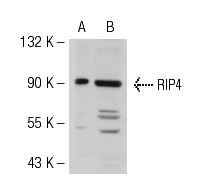
Western blot analysis of RIP4 expression in 293T (A) and HeLa (B) whole cell lysates.Application
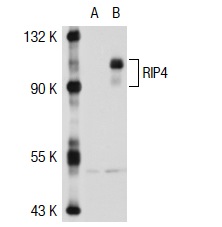
Western blot analysis of RIP4 expression in non-transfected: (A) and mouse RIP4 transfected: (B) 293T whole cell lysates.| Product Name | RIP4 Antibody (N-16) |
|---|---|
| Antibody Type | Primary Antibodies |
| Antigen Alias | epitope mapping near the N-terminus of RIP4 of human origin |
| Modification Notes | The phosphorylation and dephosphorylation of proteins on serine and threonine residues is an essential means of regulating a broad range of cellular functions in eukaryotes, including cell division, homeostasis and apoptosis. A group of proteins that are intimately involved in this process are the serine/threonine (Ser/Thr) protein kinases. RIP4, also known as RIPK4 (receptor-interacting serine/threonine-protein kinase 4), PKK (PKC ∂-interacting protein kinase), DIK, ANKK2 or ANKRD3 (ankyrin repeat domain-containing protein 3), is a peripheral membrane protein that belongs to the TKL Ser/Thr protein kinase family and functions as a receptor-interacting protein (RIP) that modulates epidermal growth and differentiation. RIPs interact with the intracellular domain of tumor necrosis factor receptors (TNFRs) and facilitate downstream signaling and apoptosis induction. RIP4 contains ten ankyrin-repeats and one protein kinase domain, and participates in the activation of NF˚B. Two isoforms exist due to alternative splicing events. |
| Clonality | Polyclonal |
|---|---|
| Isotype | IgG |
| Host Species | Rabbit |
| Tested Applications | WBIPIFELISA |
| recommended for detection of RIP4 of mouse, rat and human origin by WB, IP, IF and ELISA also reactive with additional species, including bovine and porcine: |
|
| Species Reactivity | HumanMouseRat |
| Concentration | 1mg/ml |
| Purification | Affinity purified |
| Alternative Names | epitope mapping near the N-terminus of RIP4 of human origin |
|---|---|
| Tissue Specificity | epitope mapping near the N-terminus of RIP4 of human origin |
| Entrez Gene | 54101 |
|---|
Application
Western blot analysis of RIP4 expression in 293T (A) and HeLa (B) whole cell lysates.
Application
Western blot analysis of RIP4 expression in non-transfected: (A) and mouse RIP4 transfected: (B) 293T whole cell lysates.| Application Notes | recommended for detection of RIP4 of mouse, rat and human origin by WB, IP, IF and ELISA also reactive with additional species, including bovine and porcine: |
|---|
| Form | Liquid |
|---|---|
| Storage Instructions | For short-term storage, store at 4° C. For long-term storage, aliquot and store at -20ºC or below. Avoid multiple freeze-thaw cycles. |
| Storage Buffer | phosphate buffered saline , pH 7.4, 150mM NaCl, 0.02% sodium azide and 50% glycerol. |


