Application
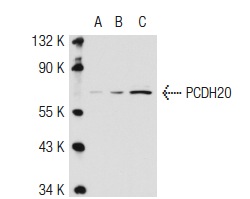
Western blot analysis of PCDH20 expression in non-transfected 293: (A), human PCDH20 transfected 293: (B) and MCF7 (C) whole cell lysates.| Product Name | PCDH20 Antibody (N-19) |
|---|---|
| Antibody Type | Primary Antibodies |
| Antigen Alias | epitope mapping within an N-terminal extracellular domain of PCDH20 of human origin |
| Modification Notes | As a subfamily of the cadherin superfamily, protocadherins are cadherin-like cell adhesion proteins that contain up to seven extracellular domains and are predominantly expressed in the nervous system. Importantly, the adhesion mechanism of protocadherins is distinct from classic cadherins. Through inactivation or overexpression, several protocadherins have been implicated in a variety of cancers. Protocadherin-20 (PCDH20), also known as protocadherin-13, is a 924 amino acid protein containing 6 cadherin domains and potentially functioning as a calcium-dependent cell-adhesion protein. In non-small cell lung cancer cell lines, a homozygous loss of PCDH20 was identified through either deletion of one allele and methylation of the other or methylation of both alleles. Hypermethylation of PCDH20 is associated with worse prognosis and clinical outcome, suggesting that PCDH20 may function as a tumor suppressor. |
| Clonality | Polyclonal |
|---|---|
| Isotype | IgG |
| Host Species | Rabbit |
| Tested Applications | WBIPIFELISA |
| recommended for detection of PCDH20 of mouse, rat and human origin by WB, IP, IF and ELISA non cross-reactive with other PCDH family members. also reactive with additional species, including equine, canine, bovine and avian: |
|
| Species Reactivity | HumanMouseRat |
| Concentration | 1mg/ml |
| Purification | Affinity purified |
| Alternative Names | epitope mapping within an N-terminal extracellular domain of PCDH20 of human origin |
|---|---|
| Tissue Specificity | epitope mapping within an N-terminal extracellular domain of PCDH20 of human origin |
| Entrez Gene | 64881 |
|---|
Application
Western blot analysis of PCDH20 expression in non-transfected 293: (A), human PCDH20 transfected 293: (B) and MCF7 (C) whole cell lysates.| Application Notes | recommended for detection of PCDH20 of mouse, rat and human origin by WB, IP, IF and ELISA non cross-reactive with other PCDH family members. also reactive with additional species, including equine, canine, bovine and avian: |
|---|
| Form | Liquid |
|---|---|
| Storage Instructions | For short-term storage, store at 4° C. For long-term storage, aliquot and store at -20ºC or below. Avoid multiple freeze-thaw cycles. |
| Storage Buffer | phosphate buffered saline , pH 7.4, 150mM NaCl, 0.02% sodium azide and 50% glycerol. |


