Application
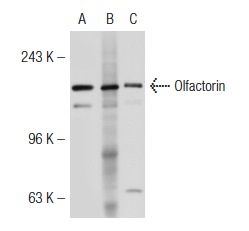
Western blot analysis of Olfactorin expression in KNRK whole cell lysate (A) and mouse thymus (B) and mouse testis (C) tissue extracts.| Product Name | Olfactorin Antibody (S-16) |
|---|---|
| Antibody Type | Primary Antibodies |
| Antigen Alias | epitope mapping within an extracellular domain of Olfactorin of human origin |
| Modification Notes | Olfactorin, also known as UMODL1 (uromodulin-like 1), is a 1,318 amino acid single-pass type I membrane protein that localizes to both the cell membrane and the cytoplasm. Expressed as four tissue-specific isoforms (isoform 3 is present in testis, prostate and fetal thymus, while isoforms 4 is present in kidney and testis), Olfactorin is thought to play a role in the maturation of the olfactory system and may participate in developmental neurobiology events. Olfactorin contains several functional domains, including one ZP domain, one WAP domain, one EMI domain, two SEA domains, two fibronectin type-III domains and three EGF-like domains. Defects in the gene encoding Olfactorin may contribute to an increased susceptibility for high myopia, a degenerative condition that effects overall eye structure and vision. |
| Clonality | Polyclonal |
|---|---|
| Isotype | IgG |
| Host Species | Rabbit |
| Tested Applications | WBIPIFELISA |
| recommended for detection of Olfactorin of mouse, rat and human origin by WB, IP, IF and ELISA also reactive with additional species, including equine, canine and bovine: |
|
| Species Reactivity | HumanMouseRat |
| Concentration | 1mg/ml |
| Purification | Affinity purified |
| Alternative Names | epitope mapping within an extracellular domain of Olfactorin of human origin |
|---|---|
| Tissue Specificity | epitope mapping within an extracellular domain of Olfactorin of human origin |
| Entrez Gene | 89766 |
|---|
Application
Western blot analysis of Olfactorin expression in KNRK whole cell lysate (A) and mouse thymus (B) and mouse testis (C) tissue extracts.| Application Notes | recommended for detection of Olfactorin of mouse, rat and human origin by WB, IP, IF and ELISA also reactive with additional species, including equine, canine and bovine: |
|---|
| Form | Liquid |
|---|---|
| Storage Instructions | For short-term storage, store at 4° C. For long-term storage, aliquot and store at -20ºC or below. Avoid multiple freeze-thaw cycles. |
| Storage Buffer | phosphate buffered saline , pH 7.4, 150mM NaCl, 0.02% sodium azide and 50% glycerol. |


