Application
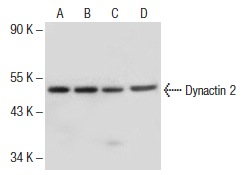
Western blot analysis of Dynactin 2 expression in MCF7 (A), HeLa (B) and K-562 (C) whole cell lysates and mouse brain tissue extract (D).| Product Name | Dynactin 2 Antibody (H-300) |
|---|---|
| Antibody Type | Primary Antibodies |
| Modification Notes | Dynactin is a multisubunit complex that functions as a binding partner for the Dynein microtubule motor. Dynactin-Dynein binding may be required for most, if not all, cytoplasmic Dynein-driven activities and is thought to contribute to the functional diversity of Dynein. Dynactin 2, also known as DCTN2, Dynamitin or DCTN50, is a peripheral membrane protein that is one of many subunits in the Dynactin complex. Like other Dynactin subunits, Dynactin 2 mediates Dynein-organelle binding and helps to regulate chromosome alignment during prometaphase and spindle organization during mitosis. Overexpression of Dynactin 2 disrupts the Dynactin-Dynein complex, thus inhibiting retrograde axonal transport and causing motor neuron degeneration. Additionally, overexpression of Dynactin 2 may disrupt the cell cycle and lead to osteosarcoma, suggesting a possible role for Dynactin 2 in carcinogenesis. |
| Clonality | Polyclonal |
|---|---|
| Isotype | IgG |
| Host Species | Rabbit |
| Tested Applications | WBIPIFELISA |
| recommended for detection of Dynactin 2 of mouse, rat and human origin by WB, IP, IF and ELISA also reactive with additional species, including equine, canine, bovine and porcine | |
| Species Reactivity | HumanMouseRat |
| Concentration | 1mg/ml |
| Purification | Affinity purified |
| Alternative Names | epitope corresponding to amino acids 102-401 mapping at the C-terminus of Dynactin 2 of human origin |
|---|---|
| Tissue Specificity | epitope corresponding to amino acids 102-401 mapping at the C-terminus of Dynactin 2 of human origin |
Application
Western blot analysis of Dynactin 2 expression in MCF7 (A), HeLa (B) and K-562 (C) whole cell lysates and mouse brain tissue extract (D).| Application Notes | recommended for detection of Dynactin 2 of mouse, rat and human origin by WB, IP, IF and ELISA also reactive with additional species, including equine, canine, bovine and porcine |
|---|
| Form | Liquid |
|---|---|
| Storage Instructions | For short-term storage, store at 4° C. For long-term storage, aliquot and store at -20ºC or below. Avoid multiple freeze-thaw cycles. |
| Storage Buffer | phosphate buffered saline , pH 7.4, 150mM NaCl, 0.02% sodium azide and 50% glycerol. |


