Application
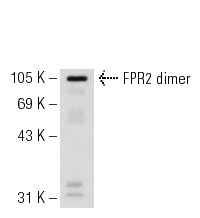
Western blot analysis of FPR2 expression in 293T whole cell lysate.| Product Name | FPR2 Antibody (M-73) |
|---|---|
| Antibody Type | Primary Antibodies |
| Modification Notes | The N-formyl peptide receptor (FPR) family is comprised of three members, FPR, FPR like-1 (FPRL1, also designated lipoxin A4 receptor, FPRH1 and FPR2) and FPR like-2 (FPRL2), all of which are chemotactic G protein-coupled receptors that contain seven transmembrane domains. These receptors are found on the surface of phagocytic leukocytes, such as neutrophils and monocytes, and each family member contains specific residues, which are responsible for determining its ligand specificity. FPRL1 is a promiscuous receptor that binds to several ligands, including lipoxin A4, N-formyl-methionyl-leucyl-phenylalanine (fMLP), serum amyloid A (SAA), prion peptide and the 42 amino acid form of b-Amyloid. Upon activation, FPRL1 induces migration and calcium mobilization in human monocytes and neutrophils and is involved in inflammatory and host defense responses. FPRL1 may mediate inflammation in prion and Alzheimer’s diseases, which makes it a potential target for therapeutic agents. |
| Clonality | Polyclonal |
|---|---|
| Isotype | IgG |
| Host Species | Rabbit |
| Tested Applications | WBIPIFELISA |
| recommended for detection of FPR2 and, to a lesser extent, other FPR family members of mouse and rat origin by WB, IP, IF and ELISA | |
| Species Reactivity | HumanMouseRat |
| Concentration | 1mg/ml |
| Purification | Affinity purified |
| Alternative Names | epitope corresponding to amino acids 208-280 mapping within an internal region of FPR2 of mouse origin |
|---|---|
| Tissue Specificity | epitope corresponding to amino acids 208-280 mapping within an internal region of FPR2 of mouse origin |
| Entrez Gene | 14289 |
|---|
Application
Western blot analysis of FPR2 expression in 293T whole cell lysate.| Application Notes | recommended for detection of FPR2 and, to a lesser extent, other FPR family members of mouse and rat origin by WB, IP, IF and ELISA |
|---|
| Form | Liquid |
|---|---|
| Storage Instructions | For short-term storage, store at 4° C. For long-term storage, aliquot and store at -20ºC or below. Avoid multiple freeze-thaw cycles. |
| Storage Buffer | phosphate buffered saline , pH 7.4, 150mM NaCl, 0.02% sodium azide and 50% glycerol. |


