Application
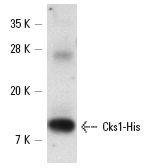
Western blot analysis of His-tagged human recombinant Cks1.Application
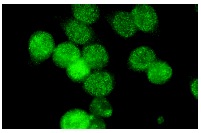
Immunofluorescence staining of methanol-fixed HeLa cells showing nuclear localization.| Product Name | Cks1/2 Antibody (FL-79) |
|---|---|
| Antibody Type | Primary Antibodies |
| Modification Notes | The Cdc2 p34-cyclin B complex plays a critical role in the cell cycle by regulating the G2 to M phase transition. Also referred to as M phase promoting factor or MPF, this complex is a required component of the cell cycle machinery and is necessary for cell entry into mitosis. The Cdc28 protein represents the S. cerevisiae counterpart of human Cdc2 p34 and has been found complexed to a regulatory protein, termed p13suc 1, in addition to cyclin B. Two proteins associated with the Cdc2 p34-cyclin B complex are called Cks1 and Cks2. Null mutations in the p13suc 1 and Cks1 genes result in the arrest of the cell cycle at either the G1 or G2 phase, suggesting that the proteins may also regulate the activity of cyclin dependent kinases that act at critical points early in the cell cycle. Cks2 (cyclin-dependent kinases regulatory subunit 2) is a 79 amino acid protein that binds to the catalytic subunit of cyclin-dependent kinases, such as those in the Cdc2 p34-cyclin B complex. An essential component of this cyclin/cyclin-dependent kinase complex, Cks2 contributes to cell cycle control and is able to form a homohexamer that can bind up to 6 subunits. Without proper activity of Cks2, the first metaphase/anaphase transition of meiosis cannot occur. |
| Clonality | Polyclonal |
|---|---|
| Isotype | IgG |
| Host Species | Rabbit |
| Tested Applications | WBIPIFELISA |
| recommended for detection of Cks1 and Cks2 of mouse, rat and human origin by WB, IP, IF and ELISA also reactive with additional species, including equine, canine, bovine, porcine and avian | |
| Species Reactivity | HumanMouseRat |
| Concentration | 1mg/ml |
| Purification | Affinity purified |
| Alternative Names | epitope corresponding to amino acids 1-79 representing full length cyclin dependent kinase regulatory subunit 1 (Cks1 p9) of human origin |
|---|---|
| Tissue Specificity | epitope corresponding to amino acids 1-79 representing full length cyclin dependent kinase regulatory subunit 1 (Cks1 p9) of human origin |
| Entrez Gene | 1163 |
|---|
Application
Western blot analysis of His-tagged human recombinant Cks1.
Application
Immunofluorescence staining of methanol-fixed HeLa cells showing nuclear localization.| Application Notes | recommended for detection of Cks1 and Cks2 of mouse, rat and human origin by WB, IP, IF and ELISA also reactive with additional species, including equine, canine, bovine, porcine and avian |
|---|
| Form | Liquid |
|---|---|
| Storage Instructions | For short-term storage, store at 4° C. For long-term storage, aliquot and store at -20ºC or below. Avoid multiple freeze-thaw cycles. |
| Storage Buffer | phosphate buffered saline , pH 7.4, 150mM NaCl, 0.02% sodium azide and 50% glycerol. |


