Application
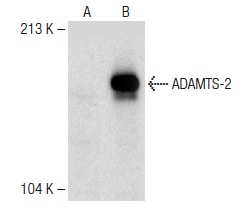
Western blot analysis of ADAMTS-2 expression in non-transfected: (A) and mouse ADAMTS-2 transfected: (B) 293T whole cell lysates.| Product Name | ADAMTS-2 Antibody (H-121) |
|---|---|
| Antibody Type | Primary Antibodies |
| Modification Notes | ADAMTS (a disintegrin and metalloproteinase domain with Thrombospondin type-1 modules) is a family of zinc-dependent proteases that are implicated in a variety of normal and pathological conditions, including arthritis and cancer. ADAMTS protein family members contain an N-terminal propeptide domain, a metalloproteinase domain, a disintegrin-like domain and a C-terminus that contains a varying number of thrombospondin type-1 (TSP-1) motifs. ADAMTS genes are primarily expressed in fetal tissues, including the lung, kidney and liver. ADAMTS-2 cleaves the propeptides of Collagen Type I and II, but not Collagen Type III, prior to fibril assembly. It may also play a role in development aside from collagen biosynthesis. ADAMTS-2 is secreted and associated with the extracellular matrix, with the highest levels in skin, bone, tendon and aorta. Defects in ADAMTS2 are the cause of Ehlers-Danlos syndrome type VIIC (EDS VIIC), a recessively inherited connective-tissue disorder characterized clinically by severe skin fragility and joint hypermobility. |
| Clonality | Polyclonal |
|---|---|
| Isotype | IgG |
| Host Species | Rabbit |
| Tested Applications | WBIPIFELISA |
| recommended for detection of ADAMTS-2 of human and, to a lesser extent, mouse and rat origin by WB, IP, IF and ELISA also reactive with additional species, including porcine | |
| Species Reactivity | HumanMouseRat |
| Concentration | 1mg/ml |
| Purification | Affinity purified |
| Alternative Names | epitope corresponding to amino acids 1091-1211 mapping at the C-terminus of ADAMTS-2 of human origin |
|---|---|
| Tissue Specificity | epitope corresponding to amino acids 1091-1211 mapping at the C-terminus of ADAMTS-2 of human origin |
Application
Western blot analysis of ADAMTS-2 expression in non-transfected: (A) and mouse ADAMTS-2 transfected: (B) 293T whole cell lysates.| Application Notes | recommended for detection of ADAMTS-2 of human and, to a lesser extent, mouse and rat origin by WB, IP, IF and ELISA also reactive with additional species, including porcine |
|---|
| Form | Liquid |
|---|---|
| Storage Instructions | For short-term storage, store at 4° C. For long-term storage, aliquot and store at -20ºC or below. Avoid multiple freeze-thaw cycles. |
| Storage Buffer | phosphate buffered saline , pH 7.4, 150mM NaCl, 0.02% sodium azide and 50% glycerol. |


