Application
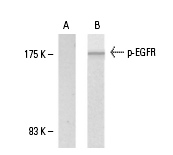
Western blot analysis of phosphorylated EGFR expression in untreated (A) and EGF-treated (B) A-431 whole cell lysates.| Product Name | p-EGFR Antibody (Thr 654) |
|---|---|
| Antibody Type | Primary Antibodies |
| Antigen Alias | epitope corresponding to phosphorylated Thr 654 of EGFR of human origin |
| Modification | Phosphoralated |
| Modification Notes | Epidermal growth factor mediates its effects on cell growth through its inter-action with a cell surface glycoprotein designated EGFR (EGF receptor). Binding of EGF or TGF alpha to EGFR activates tyrosine-specific protein kinase activity intrinsic to EGFR. The carboxy terminal tyrosine residues on EGFR, Tyr 1068 and Tyr 1173, are the major sites of autophosphorylation, which occurs as a result of EGF binding. Once activated, EGFR mediates the binding of the phosphotyrosine binding (PTB) domain of GRB2 through direct interactions with Tyr 1068 and Tyr 1086 and through indirect interactions with Tyr 1173 in the Ras signaling pathway. Tyr 1173 of EGFR also functions as a kinase substrate. Phosphorylation of Tyr 992, Tyr 1068 and Tyr 1086 is required for conformational change in the C-terminal tail of EGFR. EGFR is also subject to phosphorylation on other amino acid residues, such as Thr 654. |
| Clonality | Polyclonal |
|---|---|
| Isotype | IgG |
| Host Species | Rabbit |
| Tested Applications | WBIP |
| recommended for detection of Thr 654 phosphorylated EGFR of mouse, rat and human origin by WB and IP: |
|
| Species Reactivity | HumanMouseRat |
| Concentration | 1mg/ml |
| Purification | Affinity purified |
| Alternative Names | epitope corresponding to phosphorylated Thr 654 of EGFR of human origin |
|---|---|
| Tissue Specificity | epitope corresponding to phosphorylated Thr 654 of EGFR of human origin |
| Entrez Gene | 1956 |
|---|
Application
Western blot analysis of phosphorylated EGFR expression in untreated (A) and EGF-treated (B) A-431 whole cell lysates.| Application Notes | recommended for detection of Thr 654 phosphorylated EGFR of mouse, rat and human origin by WB and IP: |
|---|
| Form | Liquid |
|---|---|
| Storage Instructions | For short-term storage, store at 4° C. For long-term storage, aliquot and store at -20ºC or below. Avoid multiple freeze-thaw cycles. |
| Storage Buffer | phosphate buffered saline , pH 7.4, 150mM NaCl, 0.02% sodium azide and 50% glycerol. |


