Application
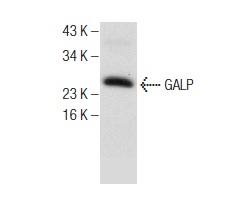
Western blot analysis of GALP expression in MDA-MB-231 whole cell lysate.Application
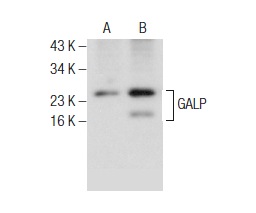
Western blot analysis of GALP expression in non-transfected: (A) and mouse GALP transfected: (B) 293T whole cell lysates.| Product Name | GALP Antibody (D-14) |
|---|---|
| Antibody Type | Primary Antibodies |
| Modification Notes | The galanin family of proteins are key members for inflammatory processes and cell proliferation, and may function as potential biomarkers for colon cancer. Produced in both neuronal and nonneuronal cells in the skin, members of the galanin family include galanin, galanin-message associated peptide, galanin-like peptide and alarin. GALP, also known as galanin-like peptide, is a 116 amino acid secreted protein belonging to the galanin family. Mainly produced in the arcuate nucleus of the hypothalamus (ARC) and the posterior pituitary, GALP is thought to function in CNS homeostatic processes, including the regulation of gonadotropin-releasing hormone secretion. GALP binds to the G-protein coupled galanin receptors, including GALR1, GALR2 and GALR3, and may also play a role in energy metabolism, with significant implications towards obesity. GALP exits as two alternatively spliced isoforms. |
| Clonality | Polyclonal |
|---|---|
| Isotype | IgG |
| Host Species | Rabbit |
| Tested Applications | WBIPIFELISA |
| recommended for detection of GALP of human and, to a lesser extent, mouse origin by WB, IP, IF and ELISA non cross-reactive with Alarin isoform | |
| Species Reactivity | HumanMouseRat |
| Concentration | 1mg/ml |
| Purification | Affinity purified |
| Alternative Names | epitope mapping within an internal region of GALP of human origin |
|---|---|
| Tissue Specificity | epitope mapping within an internal region of GALP of human origin |
| Entrez Gene | 85569 |
|---|
Application
Western blot analysis of GALP expression in MDA-MB-231 whole cell lysate.
Application
Western blot analysis of GALP expression in non-transfected: (A) and mouse GALP transfected: (B) 293T whole cell lysates.| Application Notes | recommended for detection of GALP of human and, to a lesser extent, mouse origin by WB, IP, IF and ELISA non cross-reactive with Alarin isoform |
|---|
| Form | Liquid |
|---|---|
| Storage Instructions | For short-term storage, store at 4° C. For long-term storage, aliquot and store at -20ºC or below. Avoid multiple freeze-thaw cycles. |
| Storage Buffer | phosphate buffered saline , pH 7.4, 150mM NaCl, 0.02% sodium azide and 50% glycerol. |


