Application
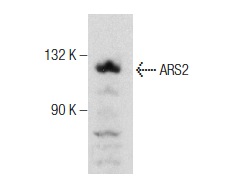
Western blot analysis of ARS2 expression in Jurkat whole cell lysate.Application
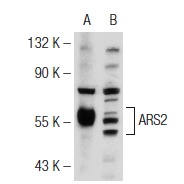
Western blot analysis of ARS2 expression in mouse lymph node tissue extract (A) and T24 whole cell lysate (B).| Product Name | ARS2 Antibody (H-300) |
|---|---|
| Antibody Type | Primary Antibodies |
| Antigen Alias | epitope corresponding to amino acids 577-876 mapping at the C-terminus of ARS2 of human origin |
| Modification Notes | ARS2 (arsenate (or arsenite-) resistance protein 2), also known as ASR2, is an 876 amino acid protein that belongs to the ARS2 family. Expressed ubiquitously in mammals and localized to the nucleus, ARS2 is evolutionarily conserved (at least 98% sequence identity among mammals) and appears to be essential for early mammalian development with a likely role in vital cellular processes. Mouse embryos lacking ARS2 exhibit excessive apoptosis and die around the time of implantation. In humans, ARS2 is known to interact with RNPS1, a protein involved in the activation of pre-mRNA splicing. In addition, the gene encoding ARS2 is located on chromosome 7 within the region that is commonly deleted in myeloid leukemia. This suggests a possible role of ARS2 in the development of myeloid leukemia. Due to alternative splicing events, ARS2 exists in four isoforms, namely isoform A, isoform B, isoform 3 and isoform 4. |
| Clonality | Polyclonal |
|---|---|
| Isotype | IgG |
| Host Species | Rabbit |
| Tested Applications | WBIPIFELISA |
| recommended for detection of ARS2 of mouse, rat and human origin by WB, IP, IF and ELISA also reactive with additional species, including equine, canine, bovine and porcine: |
|
| Species Reactivity | HumanMouseRat |
| Concentration | 1mg/ml |
| Purification | Affinity purified |
| Alternative Names | epitope corresponding to amino acids 577-876 mapping at the C-terminus of ARS2 of human origin |
|---|---|
| Tissue Specificity | epitope corresponding to amino acids 577-876 mapping at the C-terminus of ARS2 of human origin |
| Entrez Gene | 51593 |
|---|
Application
Western blot analysis of ARS2 expression in Jurkat whole cell lysate.
Application
Western blot analysis of ARS2 expression in mouse lymph node tissue extract (A) and T24 whole cell lysate (B).| Application Notes | recommended for detection of ARS2 of mouse, rat and human origin by WB, IP, IF and ELISA also reactive with additional species, including equine, canine, bovine and porcine: |
|---|
| Form | Liquid |
|---|---|
| Storage Instructions | For short-term storage, store at 4° C. For long-term storage, aliquot and store at -20ºC or below. Avoid multiple freeze-thaw cycles. |
| Storage Buffer | phosphate buffered saline , pH 7.4, 150mM NaCl, 0.02% sodium azide and 50% glycerol. |


