Application
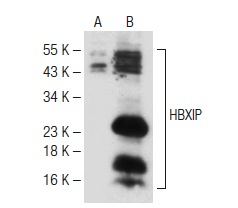
Western blot analysis of HBXIP expression in non-transfected: (A) and human HBXIP transfected: (B) 293T whole cell lysates.| Product Name | HBXIP Antibody (FL-91) |
|---|---|
| Antibody Type | Primary Antibodies |
| Antigen Alias | epitope corresponding to amino acids 1-91 representing full length HBXIP of human origin |
| Modification Notes | HBXIP (hepatitis B virus X-interacting protein), also known as HBV X-interacting protein or HBX-interacting protein, was originally identified by its ability to form a complex with the C-terminus of hepatitis B virus X (HBX) protein. HBXIP negatively regulates the activity of HBX and alters the replicative life cycle of the virus. HBXIP is an evolutionarily conserved protein. It contains a leucine zipper motif and two consensus phosphorylation sites. HBXIP also forms complexes with survivin (an overexpressed protein in most human cancers) and is necessary for allowing survivin to bind and inhibit the activation of pro-caspase-9, suggesting that HBXIP acts as an anti-apoptotic cofactor of survivin. In addition, HBXIP is involved in bipolar spindle formation and regulates centrosome dynamics and cytokinesis in cells, possibly through an interaction with Dynein light chain. The overexpression of HBXIP promotes proliferation in a variety of cells lines. |
| Clonality | Polyclonal |
|---|---|
| Isotype | IgG |
| Host Species | Rabbit |
| Tested Applications | WBIPIFELISA |
| recommended for detection of HBX-interacting protein of mouse, rat and human origin by WB, IP, IF and ELISA also reactive with additional species, including equine, canine, bovine, porcine and avian: |
|
| Species Reactivity | HumanMouseRat |
| Concentration | 1mg/ml |
| Purification | Affinity purified |
| Alternative Names | epitope corresponding to amino acids 1-91 representing full length HBXIP of human origin |
|---|---|
| Tissue Specificity | epitope corresponding to amino acids 1-91 representing full length HBXIP of human origin |
| Entrez Gene | 10542 |
|---|
Application
Western blot analysis of HBXIP expression in non-transfected: (A) and human HBXIP transfected: (B) 293T whole cell lysates.| Application Notes | recommended for detection of HBX-interacting protein of mouse, rat and human origin by WB, IP, IF and ELISA also reactive with additional species, including equine, canine, bovine, porcine and avian: |
|---|
| Form | Liquid |
|---|---|
| Storage Instructions | For short-term storage, store at 4° C. For long-term storage, aliquot and store at -20ºC or below. Avoid multiple freeze-thaw cycles. |
| Storage Buffer | phosphate buffered saline , pH 7.4, 150mM NaCl, 0.02% sodium azide and 50% glycerol. |


