Application
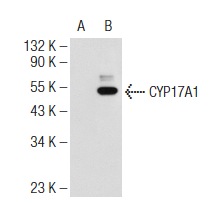
Western blot analysis of CYP17A1 expression in non-transfected: (A) and human CYP17A1 transfected: (B) 293T whole cell lysates.| Product Name | CYP17A1 Antibody (H-48) |
|---|---|
| Antibody Type | Primary Antibodies |
| Antigen Alias | epitope corresponding to amino acids 461-508 mapping at the C-terminus of CYP17A1 of human origin |
| Modification Notes | The cytochrome P450 proteins are monooxygenases that catalyze many reactions involved in drug metabolism and synthesis of cholesterol, steroids and other lipids. P450 enzymes are classified into subfamilies, such as CYP1A, CYP2A, CYP2C, CYP2D, CYP4A14, CYP7A, CYP7B, CYP8B, CYP11A, CYP17A1, CYPI9 and CYP27A, based on sequence similarities. CYP17A (17alpha-hydroxylase/17,20-lyase) is important for the conversion of pregnenolone and progesterone to dehydroepiandrosterone (DHEA) and androstenedione. In this process, it catalyzes both the 17-alpha-hydroxylation and the 17,20-lyase reaction. CYP17A1 is crucial during sexual development, both during fetal development and during puberty, and is intracellularly regulated by cAMP levels. Defects in the CYP17A1 gene, which encodes for the protein, may cause adrenal hyperplasia type V (AH-V) which is characterized by hypokalemia and hypertension. Male patients affected by AH-V do not undergo normal sexual differentiation and develop female external genitalia and do not undergo pubertal develoment. |
| Clonality | Polyclonal |
|---|---|
| Isotype | IgG |
| Host Species | Rabbit |
| Tested Applications | WBIPIFELISA |
| recommended for detection of CYP17A1 of human and, to a lesser extent, mouse and rat origin by WB, IP, IF and ELISA also reactive with additional species, including equine, canine and feline: |
|
| Species Reactivity | HumanMouseRat |
| Concentration | 1mg/ml |
| Purification | Affinity purified |
| Alternative Names | epitope corresponding to amino acids 461-508 mapping at the C-terminus of CYP17A1 of human origin |
|---|---|
| Tissue Specificity | epitope corresponding to amino acids 461-508 mapping at the C-terminus of CYP17A1 of human origin |
| Entrez Gene | 1586 |
|---|
Application
Western blot analysis of CYP17A1 expression in non-transfected: (A) and human CYP17A1 transfected: (B) 293T whole cell lysates.| Application Notes | recommended for detection of CYP17A1 of human and, to a lesser extent, mouse and rat origin by WB, IP, IF and ELISA also reactive with additional species, including equine, canine and feline: |
|---|
| Form | Liquid |
|---|---|
| Storage Instructions | For short-term storage, store at 4° C. For long-term storage, aliquot and store at -20ºC or below. Avoid multiple freeze-thaw cycles. |
| Storage Buffer | phosphate buffered saline , pH 7.4, 150mM NaCl, 0.02% sodium azide and 50% glycerol. |


