Application
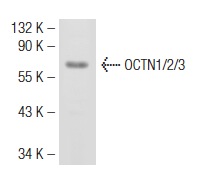
Western blot analysis of OCTN1/2/3 expression in mouse testis tissue extract.| Product Name | OCTN1/2/3 Antibody (H-130) |
|---|---|
| Antibody Type | Primary Antibodies |
| Antigen Alias | epitope corresponding to amino acids 1-130 mapping at the N-terminus of OCTN2 of human origin |
| Modification Notes | Carnitine (b-hydroxy-g-trimethylaminobutyrate) is a small, highly polar compound that aids in the b-oxidation of long-chain fatty acids. Organic cation/carnitine transporters (OCTN) assist in the elimination of cationic compounds, including xenobiotics, and transport carnitine for reabsorption in the kidney. Similar to organic cation transporters (OCT), OCTN proteins localize to the plasma membrane of epithelial cells. OCTN1 is expressed in kidney, trachea, bone marrow and fetal liver. OCTN2 is abundantly expressed in kidney, skeletal muscle, placenta and heart. OCTN3 is strongly expressed in testis and weakly expressed in kidney. The gene encoding human OCTN1 maps to chromosome 5 and the gene encoding human OCTN2 maps to chromosome 5q31. Mutations in the gene encoding OCTN2 leads to systemic carnitine deficiency (SCD), an autosomal recessive disorder characterized by cardiomyopathy, skeletal myopathy, lethargy, hypoglycemia and hyperammonemia. |
| Clonality | Polyclonal |
|---|---|
| Isotype | IgG |
| Host Species | Rabbit |
| Tested Applications | WBIPIFELISA |
| recommended for detection of OCTN1 and 2 of mouse, rat and human origin, and OCTN3 of mouse origin by WB, IP, IF and ELISA also reactive with additional species, including equine, canine, bovine and porcine: |
|
| Species Reactivity | HumanMouseRat |
| Concentration | 1mg/ml |
| Purification | Affinity purified |
| Alternative Names | epitope corresponding to amino acids 1-130 mapping at the N-terminus of OCTN2 of human origin |
|---|---|
| Tissue Specificity | epitope corresponding to amino acids 1-130 mapping at the N-terminus of OCTN2 of human origin |
| Entrez Gene | 20520 |
|---|
Application
Western blot analysis of OCTN1/2/3 expression in mouse testis tissue extract.| Application Notes | recommended for detection of OCTN1 and 2 of mouse, rat and human origin, and OCTN3 of mouse origin by WB, IP, IF and ELISA also reactive with additional species, including equine, canine, bovine and porcine: |
|---|
| Form | Liquid |
|---|---|
| Storage Instructions | For short-term storage, store at 4° C. For long-term storage, aliquot and store at -20ºC or below. Avoid multiple freeze-thaw cycles. |
| Storage Buffer | phosphate buffered saline , pH 7.4, 150mM NaCl, 0.02% sodium azide and 50% glycerol. |


