Application
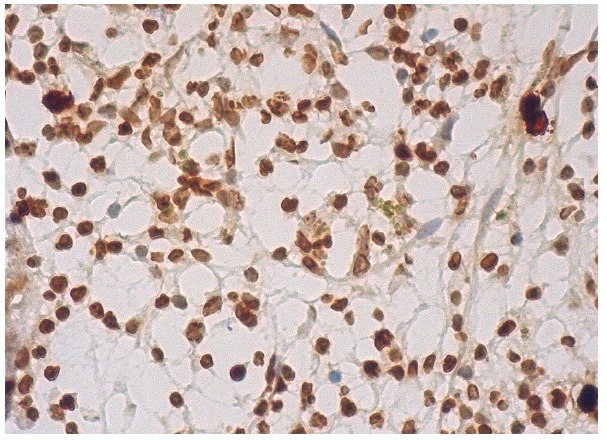
Immunoperoxidase staining of formalin fixed, paraffin-embedded human bone marrow tissue showing cytoplasmic and nuclear staining of hematopoietic cells.| Product Name | cathepsin G Antibody (H-40) |
|---|---|
| Antibody Type | Primary Antibodies |
| Antigen Alias | epitope corresponding to amino acids 216-255 mapping at the C-terminus of cathepsin G of human origin |
| Modification Notes | The cathepsin family of proteolytic enzymes contains several diverse classes of proteases. The cysteine protease class comprises cathepsins B, L, H, K, S, and O (1-6). The aspartyl protease class is composed of cathepsins D and E (7,8). Cathepsin G is in the serine protease class (9). Most cathepsins are lysosomal and each is involved in cellular metabolism, participating in various events such as peptide biosynthesis and protein degradation. Cathepsin G expression is restricted to bone marrow and early myeloid cells (9). |
| Clonality | Polyclonal |
|---|---|
| Isotype | IgG |
| Host Species | Rabbit |
| Tested Applications | WBIPIFIHCELISA |
| recommended for detection of cathepsin G of human origin by WB, IP, IF, IHC(P) and ELISA: |
|
| Species Reactivity | HumanMouseRat |
| Concentration | 1mg/ml |
| Purification | Affinity purified |
| Alternative Names | epitope corresponding to amino acids 216-255 mapping at the C-terminus of cathepsin G of human origin |
|---|---|
| Tissue Specificity | epitope corresponding to amino acids 216-255 mapping at the C-terminus of cathepsin G of human origin |
| Entrez Gene | 1511 |
|---|
Application
Immunoperoxidase staining of formalin fixed, paraffin-embedded human bone marrow tissue showing cytoplasmic and nuclear staining of hematopoietic cells.| Application Notes | recommended for detection of cathepsin G of human origin by WB, IP, IF, IHC(P) and ELISA: |
|---|
| Form | Liquid |
|---|---|
| Storage Instructions | For short-term storage, store at 4° C. For long-term storage, aliquot and store at -20ºC or below. Avoid multiple freeze-thaw cycles. |
| Storage Buffer | phosphate buffered saline , pH 7.4, 150mM NaCl, 0.02% sodium azide and 50% glycerol. |


