Application
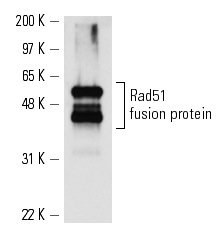
Western blot analysis of yeast recombinant Rad51 fusion protein.| Product Name | Rad51 Antibody (y-180) |
|---|---|
| Antibody Type | Primary Antibodies |
| Antigen Alias | epitope corresponding to amino acids 1-180 mapping at the N-terminus of Rad51 of Saccharomyces cerevisiae origin |
| Modification Notes | During meiotic prophase, homologous chromosomes pair with one another, undergo genetic recombination and engage in synaptonemal complex formation. These interhomolog interactions are necessary to establish chiasmata. If homologs fail to interact, or if crossing over takes place between nonhomologous chromosomes, homologs undergo nondisjunction at meiosis I and inviable meiotic products occur. Interactions between Rad51 and Rad52 are essential for DNA homologous recombination as well as for DNA double-strand break repair in S. cerevisiae. Rad54, which is inducible by X-rays, is also involved in DNA repair and recombination in S. cerevisiae. Hop2 is expressed during meiosis and may function to prevent synapsis between nonhomologous chromosomes. Hop2 is localized to chromosomes prior to and during synapsis. |
| Clonality | Polyclonal |
|---|---|
| Isotype | IgG |
| Host Species | Rabbit |
| Tested Applications | WBIPIFELISA |
| recommended for detection of Rad51 of Saccharomyces cerevisiae origin by WB, IP, IF and ELISA: |
|
| Species Reactivity | HumanMouseRat |
| Concentration | 1mg/ml |
| Purification | Affinity purified |
| Alternative Names | epitope corresponding to amino acids 1-180 mapping at the N-terminus of Rad51 of Saccharomyces cerevisiae origin |
|---|---|
| Tissue Specificity | epitope corresponding to amino acids 1-180 mapping at the N-terminus of Rad51 of Saccharomyces cerevisiae origin |
Application
Western blot analysis of yeast recombinant Rad51 fusion protein.| Application Notes | recommended for detection of Rad51 of Saccharomyces cerevisiae origin by WB, IP, IF and ELISA: |
|---|
| Form | Liquid |
|---|---|
| Storage Instructions | For short-term storage, store at 4° C. For long-term storage, aliquot and store at -20ºC or below. Avoid multiple freeze-thaw cycles. |
| Storage Buffer | phosphate buffered saline , pH 7.4, 150mM NaCl, 0.02% sodium azide and 50% glycerol. |


