Application
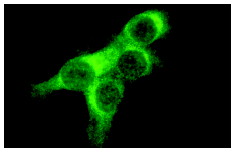
Immunofluorescence staining of methanol-fixed NIH/3T3 cells showing cytoplasmic localization.| Product Name | Cas-L Antibody (H-70) |
|---|---|
| Antibody Type | Primary Antibodies |
| Antigen Alias | epitope corresponding to amino acids 765-834 mapping at the C-terminus of Cas-L of human origin |
| Modification Notes | Cas family proteins are adhesion docking molecules that mediate protein-protein interactions and contribute to a number of signal transduction pathways. Cas-L (also designated human enhancer of filamentation (HEF1) and neural precursor cell expressed, developmentally down-regulated 9 (NEDD9), participates in integrin and growth factor signaling pathways that regulate growth, motility and apoptosis. Cas-L consists of two isoforms, p105 and p115. The larger molecular weight form is a result of Ser/Thr phosphorylation. Cas-L phosphorylation is dependent on cell adhesion and Src kinase activity. Cas-L acts as a downstream effector of FAK in the invasive behavior of glioblastoma cells. TGF∫1 regulates Cas-L gene expression and influences phosphorylation. Adhesion-dependent Actin organization regulates proteasomal turnover of Cas-L through the activity of PP2A. Tyrosine phosphorylated Cas-L can bind FAK in dendrite and soma of neurons after ischemia. Cas-L can promote neurite outgrowth of PC-12 cells. |
| Clonality | Polyclonal |
|---|---|
| Isotype | IgG |
| Host Species | Rabbit |
| Tested Applications | WBIPIFELISA |
| recommended for detection of Cas-L of mouse, rat and human origin by WB, IP, IF and ELISA also reactive with additional species, including equine, canine, bovine and porcine: |
|
| Species Reactivity | HumanMouseRat |
| Concentration | 1mg/ml |
| Purification | Affinity purified |
| Alternative Names | epitope corresponding to amino acids 765-834 mapping at the C-terminus of Cas-L of human origin |
|---|---|
| Tissue Specificity | epitope corresponding to amino acids 765-834 mapping at the C-terminus of Cas-L of human origin |
| Entrez Gene | 4739 |
|---|
Application
Immunofluorescence staining of methanol-fixed NIH/3T3 cells showing cytoplasmic localization.| Application Notes | recommended for detection of Cas-L of mouse, rat and human origin by WB, IP, IF and ELISA also reactive with additional species, including equine, canine, bovine and porcine: |
|---|
| Form | Liquid |
|---|---|
| Storage Instructions | For short-term storage, store at 4° C. For long-term storage, aliquot and store at -20ºC or below. Avoid multiple freeze-thaw cycles. |
| Storage Buffer | phosphate buffered saline , pH 7.4, 150mM NaCl, 0.02% sodium azide and 50% glycerol. |


