Application
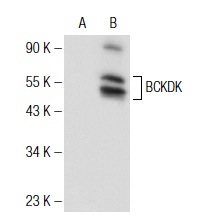
Western blot analysis of BCKDK expression in non-transfected: (A) and human BCKDK transfected: (B) 293T whole cell lysates.| Product Name | BCKDK Antibody (H-280) |
|---|---|
| Antibody Type | Primary Antibodies |
| Antigen Alias | epitope corresponding to amino acids 1-280 mapping at the N-terminus of BCKDK of human origin |
| Modification Notes | BCKDK (branched chain ketoacid dehydrogenase kinase), also known as BCKDHKIN, is a 412 amino acid mitochondrial matrix protein that exists as a monomer and contains one histidine kinase domain. Expressed ubiquitously, BCKDK catalyzes the ATP-dependent phosphorylation and subsequent inactivation of the branched-chain alpha-ketoacid dehydrogenase (BCKD) complex, a regulatory enzyme complex that plays a crucial role in the catabolic pathways of valine, leucine and isoleucine. Specifically, the BCKD complex functions as the second enzyme in branched-chain amino acid (BCAA) catabolism, effectively catalyzing the irreversible oxidative decarboxylation of BCAAs. Due to the ability of BCKDK to regulate the activity of the BCKD complex, BCKDK plays an essential role in the catabolic pathways of branched-chain amino acid metabolism. |
| Clonality | Polyclonal |
|---|---|
| Isotype | IgG |
| Host Species | Rabbit |
| Tested Applications | WBIPIFELISA |
| recommended for detection of BCKDK of mouse, rat and human origin by WB, IP, IF and ELISA also reactive with additional species, including equine, canine, bovine and porcine: |
|
| Species Reactivity | HumanMouseRat |
| Concentration | 1mg/ml |
| Purification | Affinity purified |
| Alternative Names | epitope corresponding to amino acids 1-280 mapping at the N-terminus of BCKDK of human origin |
|---|---|
| Tissue Specificity | epitope corresponding to amino acids 1-280 mapping at the N-terminus of BCKDK of human origin |
Application
Western blot analysis of BCKDK expression in non-transfected: (A) and human BCKDK transfected: (B) 293T whole cell lysates.| Application Notes | recommended for detection of BCKDK of mouse, rat and human origin by WB, IP, IF and ELISA also reactive with additional species, including equine, canine, bovine and porcine: |
|---|
| Form | Liquid |
|---|---|
| Storage Instructions | For short-term storage, store at 4° C. For long-term storage, aliquot and store at -20ºC or below. Avoid multiple freeze-thaw cycles. |
| Storage Buffer | phosphate buffered saline , pH 7.4, 150mM NaCl, 0.02% sodium azide and 50% glycerol. |


