Application
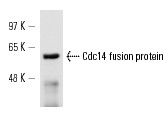
Western blot analysis of yeast recombinant Cdc14 fusion protein.Application
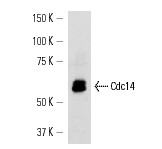
Western blot analysis of Cdc14 expression in yeast extract.| Product Name | Cdc14 Antibody (y-300) |
|---|---|
| Antibody Type | Primary Antibodies |
| Antigen Alias | epitope corresponding to amino acids 252-551 mapping at the C-terminus of Cdc14 of Saccharomyces cerevisiae origin |
| Modification Notes | Cell cycle progression is controlled at a point late in G1 designated Start. The key cell cycle transitions in Saccharomyces cerevisiae are G1 to S, metaphase to anaphase, and the exit from mitosis, all of which are regulated by a complex network of proteins (1). The specific set of proteins required for the exit from mitosis include Tem1, Lte1, Cdc15, Dbf2/Dbf20, Cdc5, Mob1, and Cdc14 (1-2). Cdc14 is a dual specificity protein phosphatase that inactivates mitotic cyclin-dependent kinases (Cdks) (1,3-5). It is tethered to the nucleolus by the action of Net1, but is released in late anaphase/telophase by Tem1, a GTP-binding protein (1,2,6). Mutations in these genes arrest cells in late anaphase/telophase, which indicates that Cdc14 and Tem1 are necessary for the termination of the M phase in the cell cycle (1). |
| Clonality | Polyclonal |
|---|---|
| Isotype | IgG |
| Host Species | Rabbit |
| Tested Applications | WBIPIFELISA |
| recommended for detection of Cdc14 of Saccharomyces cerevisiae origin by WB, IP, IF and ELISA: |
|
| Species Reactivity | HumanMouseRat |
| Concentration | 1mg/ml |
| Purification | Affinity purified |
| Alternative Names | epitope corresponding to amino acids 252-551 mapping at the C-terminus of Cdc14 of Saccharomyces cerevisiae origin |
|---|---|
| Tissue Specificity | epitope corresponding to amino acids 252-551 mapping at the C-terminus of Cdc14 of Saccharomyces cerevisiae origin |
Application
Western blot analysis of yeast recombinant Cdc14 fusion protein.
Application
Western blot analysis of Cdc14 expression in yeast extract.| Application Notes | recommended for detection of Cdc14 of Saccharomyces cerevisiae origin by WB, IP, IF and ELISA: |
|---|
| Form | Liquid |
|---|---|
| Storage Instructions | For short-term storage, store at 4° C. For long-term storage, aliquot and store at -20ºC or below. Avoid multiple freeze-thaw cycles. |
| Storage Buffer | phosphate buffered saline , pH 7.4, 150mM NaCl, 0.02% sodium azide and 50% glycerol. |


