Application
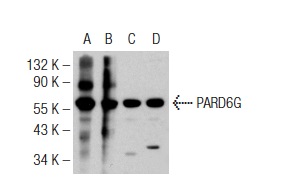
Western blot analysis of PARD6G expression in mouse thymus (A) and mouse spleen (B) tissue extracts and LADMAC (C) and WI 38 (D) whole cell lysates.| Product Name | PARD6G Antibody (N-15) |
|---|---|
| Antibody Type | Primary Antibodies |
| Antigen Alias | epitope mapping at the N-terminus of PARD6G of human origin |
| Modification Notes | PARD6G (partitioning defective 6 homolog gamma) is a 376 amino acid adaptor protein that is involved in cell polarization and asymmetrical cell division processes. PARD6G contains one OPR domain, one PDZ (DHR) domain and one pseudo-CRIB domain. The PDZ and pseudo-CRIB domains are required for interaction with Rho small GTPases. Through its complex formation with PARD3G, PARD6G participates in the linking of GTP-bound Rho small GTPases to atypical protein kinase C (PKC) proteins. This assembly is involved in formation of normal tight junctions at epithelial cell-cell contacts. When atypical PKC and PARD6G are expressed with a constitutively active RAC, the proteins colocalize to the membrane ruffles, which are structures that occur at the leading edge of polarized cells during movement. Though widely expressed, PARD6G is found at highest levels in adult and fetal kidney. |
| Clonality | Polyclonal |
|---|---|
| Isotype | IgG |
| Host Species | Rabbit |
| Tested Applications | WBIPIFELISA |
| recommended for detection of PARD6G of mouse, rat and human origin by WB, IP, IF and ELISA non cross-reactive with other PARD family members also reactive with additional species, including bovine and porcine: |
|
| Species Reactivity | HumanMouseRat |
| Concentration | 1mg/ml |
| Purification | Affinity purified |
| Alternative Names | epitope mapping at the N-terminus of PARD6G of human origin |
|---|---|
| Tissue Specificity | epitope mapping at the N-terminus of PARD6G of human origin |
| Entrez Gene | 84552 |
|---|
Application
Western blot analysis of PARD6G expression in mouse thymus (A) and mouse spleen (B) tissue extracts and LADMAC (C) and WI 38 (D) whole cell lysates.| Application Notes | recommended for detection of PARD6G of mouse, rat and human origin by WB, IP, IF and ELISA non cross-reactive with other PARD family members also reactive with additional species, including bovine and porcine: |
|---|
| Form | Liquid |
|---|---|
| Storage Instructions | For short-term storage, store at 4° C. For long-term storage, aliquot and store at -20ºC or below. Avoid multiple freeze-thaw cycles. |
| Storage Buffer | phosphate buffered saline , pH 7.4, 150mM NaCl, 0.02% sodium azide and 50% glycerol. |


