Application
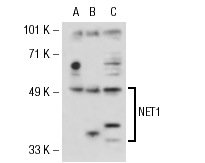
Western blot analysis of NET1 expression in non-transfected 293T: (A), human NET1 transfected 293T: (B) and HeLa (C) whole cell lysates.| Product Name | NET1 Antibody (H-70) |
|---|---|
| Antibody Type | Primary Antibodies |
| Antigen Alias | epitope corresponding to amino acids 106-175 mapping within an internal region of NET1 of human origin |
| Modification Notes | Numerous cellular functions such as proliferation, differentiation, apoptosis, vesicular trafficking, nuclear transport and cytoskeletal organization are controlled by GTPases. It has become increasingly clear that GTPases act in cascades in which their activities are linked by GTPase-activating proteins (GAPs) and guanine nucleotide exchange factors (GEFs). Researchers looking for new epithelial cell-specific oncogenes using a highly efficient cDNA expression cloning system have isolated the Ost oncogene from rat osteosarcoma cells. The Ost proto-oncogene protein contains DH and PH domains, catalyzes guanine nucleotide exchange on RhoA and Cdc42 and interacts specifically with the GTP-bound form of Rac1. The related NET1 protein also contains a DH domain and is ubiquitously expressed in a variety of tissues. Overexpression of NET1 in NIH/3T3 cells results in altered growth properties and tumorigenesis when injected into nude mice. |
| Clonality | Polyclonal |
|---|---|
| Isotype | IgG |
| Host Species | Rabbit |
| Tested Applications | WBIPIFELISA |
| recommended for detection of Rho-specific GEF NET1 of mouse, rat and human origin by WB, IP, IF and ELISA also reactive with additional species, including equine, canine, bovine and porcine: |
|
| Species Reactivity | HumanMouseRat |
| Concentration | 1mg/ml |
| Purification | Affinity purified |
| Alternative Names | epitope corresponding to amino acids 106-175 mapping within an internal region of NET1 of human origin |
|---|---|
| Tissue Specificity | epitope corresponding to amino acids 106-175 mapping within an internal region of NET1 of human origin |
| Entrez Gene | 10276 |
|---|
Application
Western blot analysis of NET1 expression in non-transfected 293T: (A), human NET1 transfected 293T: (B) and HeLa (C) whole cell lysates.| Application Notes | recommended for detection of Rho-specific GEF NET1 of mouse, rat and human origin by WB, IP, IF and ELISA also reactive with additional species, including equine, canine, bovine and porcine: |
|---|
| Form | Liquid |
|---|---|
| Storage Instructions | For short-term storage, store at 4° C. For long-term storage, aliquot and store at -20ºC or below. Avoid multiple freeze-thaw cycles. |
| Storage Buffer | phosphate buffered saline , pH 7.4, 150mM NaCl, 0.02% sodium azide and 50% glycerol. |


