Application
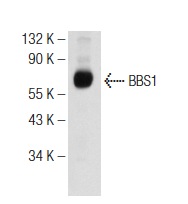
Western blot analysis of BBS1 expression in mouse embryonic brain tissue extract.| Product Name | BBS1 Antibody (H-300) |
|---|---|
| Antibody Type | Primary Antibodies |
| Antigen Alias | epitope corresponding to amino acids 291-590 mapping near the C-terminus of BBS1 of human origin |
| Modification Notes | Bardet-Biedl syndrome (BBS) is a pleiotropic genetic disorder characterized by obesity, photoreceptor degeneration, polydactyly, hypogenitalism, renal abnormalities, and developmental delay. BBS patients also have an increased risk of developing diabetes, hypertension, and congenital heart defects. BBS is a heterogeneous disorder mapping to eight genetic loci and encoding eight proteins, BBS1-BBS8. Five BBS genes encode basal body or cilia proteins, suggesting that BBS is a ciliary dysfunction disorder. BBS1 is the protein most commonly involved in Bardet-Biedl syndrome. The BBS1 gene is ubiquitously expressed, with highest abundance in in fetal tissues, testis, retina, and adipose tissue. BBS1 is highly conserved in mammals and is inherited in an autosomal recessive manner. Missense mutations in the BBS1 gene account for approximately 80% of all BBS1 mutations. |
| Clonality | Polyclonal |
|---|---|
| Isotype | IgG |
| Host Species | Rabbit |
| Tested Applications | WBIPIFELISA |
| recommended for detection of BBS1 of mouse, rat and human origin by WB, IP, IF and ELISA also reactive with additional species, including equine, canine and porcine: |
|
| Species Reactivity | HumanMouseRat |
| Concentration | 1mg/ml |
| Purification | Affinity purified |
| Alternative Names | epitope corresponding to amino acids 291-590 mapping near the C-terminus of BBS1 of human origin |
|---|---|
| Tissue Specificity | epitope corresponding to amino acids 291-590 mapping near the C-terminus of BBS1 of human origin |
Application
Western blot analysis of BBS1 expression in mouse embryonic brain tissue extract.| Application Notes | recommended for detection of BBS1 of mouse, rat and human origin by WB, IP, IF and ELISA also reactive with additional species, including equine, canine and porcine: |
|---|
| Form | Liquid |
|---|---|
| Storage Instructions | For short-term storage, store at 4° C. For long-term storage, aliquot and store at -20ºC or below. Avoid multiple freeze-thaw cycles. |
| Storage Buffer | phosphate buffered saline , pH 7.4, 150mM NaCl, 0.02% sodium azide and 50% glycerol. |


