Application
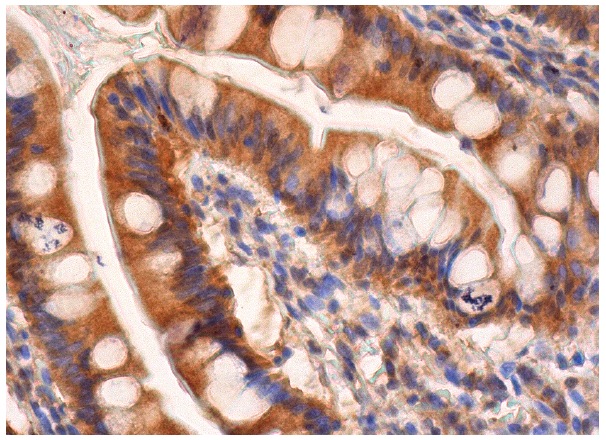
Immunoperoxidase staining of formalin fixed, paraffin-embedded human small intestine tissue showing cytoplasmic staining of glandular cells.| Product Name | Wnt-2 Antibody (H-40) |
|---|---|
| Antibody Type | Primary Antibodies |
| Antigen Alias | epitope corresponding to amino acids 231-270 mapping near the C-terminus of Wnt-2 of human origin |
| Modification Notes | Products of the highly conserved Wnt gene family, including Wnt-1 through Wnt-10, play key roles in regulating cellular growth and differentiation. Wnt-1 is a cysteine-rich, secreted glycoprotein that associates with cell membranes and likely functions as a key regulator of cellular adhesion. Wnt-1, which is essential for normal development of the embryonic nervous system, contributes to hyperplasia and tumorigenic progression when improperly expressed in mammary tissue. Wnt-3 is also involved in tumorigenesis and Wnt-2 and Wnt-4 may be associated with abnormal proliferation in human breast tissue. Wnt-1, Wnt-3 and Wnt-10b have been implicated along with FGF-3 in the development of mouse mammary tumor virus induced mouse mammary carcinomas. Wnt family members have been shown to interact with Sonic hedgehog (Shh) in vivo to induce myogenesis in somatic tissue. |
| Clonality | Polyclonal |
|---|---|
| Isotype | IgG |
| Host Species | Rabbit |
| Tested Applications | WBIPIFIHCELISA |
| recommended for detection of precursor and mature Wnt-2 of mouse, rat and human origin by WB, IP, IF, IHC(P) and ELISA also reactive with additional species, including equine, canine, bovine, porcine and avian: |
|
| Species Reactivity | HumanMouseRat |
| Concentration | 1mg/ml |
| Purification | Affinity purified |
| Alternative Names | epitope corresponding to amino acids 231-270 mapping near the C-terminus of Wnt-2 of human origin |
|---|---|
| Tissue Specificity | epitope corresponding to amino acids 231-270 mapping near the C-terminus of Wnt-2 of human origin |
| Entrez Gene | 7472 |
|---|
Application
Immunoperoxidase staining of formalin fixed, paraffin-embedded human small intestine tissue showing cytoplasmic staining of glandular cells.| Application Notes | recommended for detection of precursor and mature Wnt-2 of mouse, rat and human origin by WB, IP, IF, IHC(P) and ELISA also reactive with additional species, including equine, canine, bovine, porcine and avian: |
|---|
| Form | Liquid |
|---|---|
| Storage Instructions | For short-term storage, store at 4° C. For long-term storage, aliquot and store at -20ºC or below. Avoid multiple freeze-thaw cycles. |
| Storage Buffer | phosphate buffered saline , pH 7.4, 150mM NaCl, 0.02% sodium azide and 50% glycerol. |


