Application
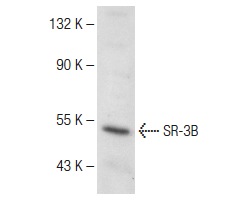
Western blot analysis of SR-3B expression in EOC 20 whole cell lysate.| Product Name | SR-3B Antibody (M-64) |
|---|---|
| Antibody Type | Primary Antibodies |
| Antigen Alias | epitope corresponding to amino acids 168-231 mapping within an internal region of SR-3B of mouse origin |
| Modification Notes | Serotonin is a molecule that functions as a neurotransmitter, a hormone and a mitogen, and it modulates several processes including psychiatric disorders, cardiovascular function and motility of the gastrointestinal tract. Serotonin receptors (also designated 5-hydroxytryptamine or 5-HT receptors) are members of the G protein-coupled receptor family that mediate the effects of serotonin. The serotonin receptors (alternatively designated SR) include SR-1, SR-2, SR-3, SR-4, SR-5, SR-6 and SR-7. The SR-1 receptors are subdivided into SR-1A, B, C, D, E and F receptors, while the SR-2 receptors comprise three subtypes: SR-2A, B and C. SR-3 is divided into SR-3A and SR-3B, a 441 amino acid protein with 41% sequence homology to SR-3A. SR-3B is responsible for fast, depolarizing responses in neurons after activation. The SR-3B protein is expressed in kidney and brain, specifically in hippocampus, thalamus and caudate nucleus, and particularly in amygdala. No expression of SR-3B is detected in heart, placenta, lung, liver, skeletal muscle or pancreas. |
| Clonality | Polyclonal |
|---|---|
| Isotype | IgG |
| Host Species | Rabbit |
| Tested Applications | WBIPIFELISA |
| recommended for detection of serotonin 3B receptor of mouse, rat and, to a lesser extent, human origin by WB, IP, IF and ELISA: |
|
| Species Reactivity | HumanMouseRat |
| Concentration | 1mg/ml |
| Purification | Affinity purified |
| Alternative Names | epitope corresponding to amino acids 168-231 mapping within an internal region of SR-3B of mouse origin |
|---|---|
| Tissue Specificity | epitope corresponding to amino acids 168-231 mapping within an internal region of SR-3B of mouse origin |
Application
Western blot analysis of SR-3B expression in EOC 20 whole cell lysate.| Application Notes | recommended for detection of serotonin 3B receptor of mouse, rat and, to a lesser extent, human origin by WB, IP, IF and ELISA: |
|---|
| Form | Liquid |
|---|---|
| Storage Instructions | For short-term storage, store at 4° C. For long-term storage, aliquot and store at -20ºC or below. Avoid multiple freeze-thaw cycles. |
| Storage Buffer | phosphate buffered saline , pH 7.4, 150mM NaCl, 0.02% sodium azide and 50% glycerol. |


