Application
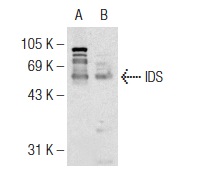
Western blot analysis of IDS expression in mouse brain (A) and mouse pancreas (B) tissue extracts.| Product Name | IDS Antibody (H-243) |
|---|---|
| Antibody Type | Primary Antibodies |
| Antigen Alias | epitope corresponding to amino acids 92-334 mapping within an internal region of IDS of human origin |
| Modification Notes | IDS (Iduronate 2-sulfatase), also known as SIDS, is a 550 amino acid protein that localizes to the lysosome and belongs to the sulfatase family. Expressed in lung, liver, kidney and placenta, IDS uses calcium as a cofactor to catalyze the hydrolysis of select sulfate groups on dermatan sulfate, heparan sulfate and heparin and, via this catalytic activity, is essential for the lysosomal degradation of both dermatan and heparan sulfate. Defects in the gene encoding IDS are the cause of mucopolysaccharidosis type 2 (MPS2), more commonly known as Hunter syndrome, which is characterized by skeletal deformities, hepatosplenomegaly and progressive cardiopulmonary deterioration, as well as neurological damage and, in some cases, death. IDS exists as two alternatively spliced isoforms, designated long and short. |
| Clonality | Polyclonal |
|---|---|
| Isotype | IgG |
| Host Species | Rabbit |
| Tested Applications | WBIPIFELISA |
| recommended for detection of IDS of mouse, rat and human origin by WB, IP, IF and ELISA also reactive with additional species, including canine and bovine: |
|
| Species Reactivity | HumanMouseRat |
| Concentration | 1mg/ml |
| Purification | Affinity purified |
| Alternative Names | epitope corresponding to amino acids 92-334 mapping within an internal region of IDS of human origin |
|---|---|
| Tissue Specificity | epitope corresponding to amino acids 92-334 mapping within an internal region of IDS of human origin |
| Entrez Gene | 3423 |
|---|
Application
Western blot analysis of IDS expression in mouse brain (A) and mouse pancreas (B) tissue extracts.| Application Notes | recommended for detection of IDS of mouse, rat and human origin by WB, IP, IF and ELISA also reactive with additional species, including canine and bovine: |
|---|
| Form | Liquid |
|---|---|
| Storage Instructions | For short-term storage, store at 4° C. For long-term storage, aliquot and store at -20ºC or below. Avoid multiple freeze-thaw cycles. |
| Storage Buffer | phosphate buffered saline , pH 7.4, 150mM NaCl, 0.02% sodium azide and 50% glycerol. |


