Application
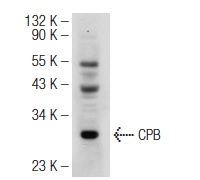
Western blot analysis of CPB expression in HeLa whole cell lysate.| Product Name | CPB Antibody (H-62) |
|---|---|
| Antibody Type | Primary Antibodies |
| Antigen Alias | epitope corresponding to amino acids 306-358 mapping within an internal region of CPB of human origin |
| Modification Notes | CPB (carboxypeptidase B), also known as CPB1, PASP (pancreas-specific protein) or PCPB, is a zinc-containing exopeptidase belonging to the A/B subfamily (or peptidase subfamily M14 A) of carboxypeptidases. CPB functions as a digestive carboxypeptidase and cleaves C-terminal basic amino acid residues from substrates. CPB is synthesized as an inactive zymogen in the endoplasmic reticulum of pancreatic acinar cells. It is then packaged into secretory granules and secreted into the lumen upon acinar cell stimulation. In the duodenum, CPB is activated by the cleavage of its N-terminal activation peptide (also known as CAPAP). CPB is widely recognized as a useful serum marker for acute pancreatitis and pancreatic graft rejection. |
| Clonality | Polyclonal |
|---|---|
| Isotype | IgG |
| Host Species | Rabbit |
| Tested Applications | WBIPIFELISA |
| recommended for detection of CPB of mouse, rat and human origin by WB, IP, IF and ELISA also reactive with additional species, including canine: |
|
| Species Reactivity | HumanMouseRat |
| Concentration | 1mg/ml |
| Purification | Affinity purified |
| Alternative Names | epitope corresponding to amino acids 306-358 mapping within an internal region of CPB of human origin |
|---|---|
| Tissue Specificity | epitope corresponding to amino acids 306-358 mapping within an internal region of CPB of human origin |
| Entrez Gene | 1360 |
|---|
Application
Western blot analysis of CPB expression in HeLa whole cell lysate.| Application Notes | recommended for detection of CPB of mouse, rat and human origin by WB, IP, IF and ELISA also reactive with additional species, including canine: |
|---|
| Form | Liquid |
|---|---|
| Storage Instructions | For short-term storage, store at 4° C. For long-term storage, aliquot and store at -20ºC or below. Avoid multiple freeze-thaw cycles. |
| Storage Buffer | phosphate buffered saline , pH 7.4, 150mM NaCl, 0.02% sodium azide and 50% glycerol. |


