Application
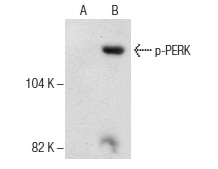
Western blot analysis of PERK phosphorylation in HeLa (A) and Thapsigargin treated HeLa (B) whole cell lysates.| Product Name | p-PERK Antibody (Thr 981) |
|---|---|
| Antibody Type | Primary Antibodies |
| Antigen Alias | PEK,HRI,WRS |
| Conjugation | Agarose |
| Modification | Phosphoralated |
| Modification Notes | PERK (eukaryotic translation initiation factor 2-alpha kinase 3, eIF2å kinase 3, PEK, WRS) is a Ser/Thr protein kinase, type I membrane protein of the endoplasmic reticulum that is abundant in secretory tissues and is inducible by ER-stress. PERK phosphorylates the å subunit of eukaryotic translation-initiation factor 2 (EIF2), leading to its inactivation, a reduction of translation initiation and repression of global protein synthesis. PERK may serve as an effector of unfolded protein response (UPR)-induced G1 growth arrest due to the loss of cyclin D1. PERK dimerizes with HSPA5/BIP in resting cells and oligomerizes in ER-stressed cells. Perturbation in protein folding in the endoplasmic reticulum (ER) can promote dissociation from HSPA5/BIP and oligomerization, resulting in autophosphorylation and kinase activity induction. |
| Clonality | Polyclonal |
|---|---|
| Isotype | IgG |
| Host Species | Rabbit |
| Tested Applications | ELISAIFIPWB |
| *Optimal dilutions/concentrations should be determined by the researcher.: WB:1:100~1:200 IF:1:20~1:100 ELISA:1:1000~5000 IP:1:20~1:100 |
|
| Species Reactivity | HumanMouseRat |
| Concentration | 1mg/ml |
| Purification | Affinity purified |
| Alternative Names | PEK HRI WRS |
|---|---|
| Tissue Specificity | recommended for detection of Thr 981 phosphorylated PERK of mouse, rat and human origin by WB, IP, IF and ELISA; also reactive with additional species, including equine, canine, bovine, porcine and avian |
| Entrez Gene | 9451 |
|---|
Application
Western blot analysis of PERK phosphorylation in HeLa (A) and Thapsigargin treated HeLa (B) whole cell lysates.| Application Notes | *Optimal dilutions/concentrations should be determined by the researcher.: WB:1:100~1:200 IF:1:20~1:100 ELISA:1:1000~5000 IP:1:20~1:100 |
|---|
| Form | Liquid |
|---|---|
| Storage Instructions | For short-term storage, store at 4° C. For long-term storage, aliquot and store at -20ºC or below. Avoid multiple freeze-thaw cycles. |
| Storage Buffer | phosphate buffered saline , pH 7.4, 150mM NaCl, 0.02% sodium azide and 50% glycerol. |


