Application
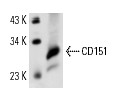
Western blot analysis of CD151 expression in human platelet whole cell lysate.| Product Name | CD151 Antibody (H-80) |
|---|---|
| Antibody Type | Primary Antibodies |
| Antigen Alias | epitope corresponding to amino acids 101-180 mapping within an extracellular domain of CD151 of human origin |
| Modification Notes | CD151 is involved in a wide variety of cell biological processes, including cell adhesion and the transport of integrins via vesicles. The human CD151 gene maps to chromosome 11p15.5 and encodes a 253-amino acid protein, which belongs to the tetraspan (4TM) superfamily. CD151 can associate with several integrin chains including b1, b3, b4, a2, a3, a5, and a6 integrins. CD151 may provide a framework for the spatial organization of both type I and type II hemidesmosomes, which are specialized junctional complexes that function as cell-attachment sites for binding to basement membranes. CD151 RNA transcript (1.6 kb) can be detected in MO7e cells, bone marrow stromal cells, C11 endothelial cells, HUVEC, and several myeloid leukemia cell lines, however, no transcript is detected in brain and the lymphoblastoid cell lines MOLT-4 and BALM-1. Leu149-Glu213 of CD151 is the interface through which integrins a3b1 can bind. CD151 can enhance cell motility, invasion, and metastasis of cancer cells in a focal adhesion kinase dependent manner. |
| Clonality | Polyclonal |
|---|---|
| Isotype | IgG |
| Host Species | Rabbit |
| Tested Applications | WBIPIFELISA |
| recommended for detection of CD151 of mouse, rat and human origin by WB, IP, IF and ELISA: |
|
| Species Reactivity | HumanMouseRat |
| Concentration | 1mg/ml |
| Purification | Affinity purified |
| Alternative Names | epitope corresponding to amino acids 101-180 mapping within an extracellular domain of CD151 of human origin |
|---|---|
| Tissue Specificity | epitope corresponding to amino acids 101-180 mapping within an extracellular domain of CD151 of human origin |
| Entrez Gene | 977 |
|---|
Application
Western blot analysis of CD151 expression in human platelet whole cell lysate.| Application Notes | recommended for detection of CD151 of mouse, rat and human origin by WB, IP, IF and ELISA: |
|---|
| Form | Liquid |
|---|---|
| Storage Instructions | For short-term storage, store at 4° C. For long-term storage, aliquot and store at -20ºC or below. Avoid multiple freeze-thaw cycles. |
| Storage Buffer | phosphate buffered saline , pH 7.4, 150mM NaCl, 0.02% sodium azide and 50% glycerol. |


